The following is in the series of comments I wrote at Street Prophets (see the previous two posts); however, this one has an additional response by the original poster and my follow-up comment (inserted in the appropriate part of the thread). Once again, original comments are in italics:
"It does seem to me that most of the Muslims here in the States are progressive."
I think this depends upon how you define "progressive." There are some Muslims, primarily in North America, who describe themselves as being "progressive." One of the other Muslim diarists here, eteraz, characterizes himself as such.
I myself would say that I am orthodox in my thinking, probably more conservative (regarding Muslim issues) than eteraz or people like him.
If you define "progressive" as in liberal American political thinking, though, I think that many American Muslims will fit that definition, at least partially. There are a number of political issues where we support the Democratic party; likewise, there are some issues that we are more conservative about. However, over all, I'd say that most Muslims vote Democratic than Republican.
Progressive, in any sense of the word. I was thinking in terms of faith as walking with God in love, not fear.
The Qur'an often talks about how we should fear Allah (swt). But the "fear" is not the normal human emotion of fear; when a Muslim talks of fearing Allah (swt), we mean that we love Him so much that we fear to displease Him in any way.
"I wish I knew more about the rules of politeness (as a woman) for covering the head, etc."
Most Muslim women cover their heads with a scarf (often called a hijab or tudung) for purposes of modesty. There is a Qur'anic verse that reads:
"And say to the believing women that they should lower their gaze and guard their modesty; that they should not display their beauty and ornaments except what (must ordinarily) appear thereof; that they should draw their veils over their bosoms and not display their beauty except to their husbands, their fathers, their husband's fathers, their sons, their husbands' sons, their brothers or their brothers' sons, or their sisters' sons, or their women, or the slaves whom their right hands possess, or male servants free of physical needs, or small children who have no sense of the shame of sex; and that they should not strike their feet in order to draw attention to their hidden ornaments. And O ye Believers! turn ye all together towards Allah, that ye may attain Bliss." (24:31)
As you can see, according to the Qur'an, only certain men are allowed to see a woman's hair. For example, I am allowed to see my wife's hair, as is her father and brother, but not my brother-in-law. Likewise, I would not normally see my sister-in-law's hair. Elderly women are allowed, per the Qur'an (24:60), not to cover themselves, although the Qur'an also suggests that it would be better for them if they did. And, of course, there are many Muslim women (especially younger women) who ignore this injunction altogether.
BTW, my wife's decision to wear a tudung is entirely her own. :)
"It also seems that the Prophet himself had great respect for the intellectual talents of the women that were close to him."
I certainly think so.
"The restrictions on contact between men and women at prayer are a stumbling block for me, since I personally believe that the soul has no sex, and that the soul is the part of me that prays."
"The spirit is willing, but the flesh is weak" or something like that. ;) This is a contentious topic among the progressives, but I don't have any problem with it. There are two basic reasons why I support the separation of the sexes during prayer (salat).
First, prior to doing salat, everyone must do a ritual bathing called wudu. Under one school of thought, the Shafi'i (which I belong to), contact between any man and woman, no matter how coincidental, will nullify the wudu for each, which means of course that both have to do wudu once more before being allowed to pray. So the Shafi'i will not allow men and women to pray together if only to preserve a state of wudu during prayer.
Second, as I'm sure you're well aware, men worldwide are, uhm, visually distracted by women. :) The purpose of salat is worship. Salat is short and intense. The prayers last for, at most, five minutes, and all distractions from the mind need to be eliminated as best as possible in order to concentrate on the worship. A five-minute separation of the sexes certainly isn't that big a deal. :) Moreover, when doing salat at home, my wife and I will often pray together; we're just careful to avoid touching each other until after salat is over.
September 9, 2006


Book Suggestions about Islam
For those of us who would like to learn more about the Islam faith, could you recommend two or three books? I've been wanting to start reading, but there's so much out there, and I'm not sure which are accurate and which are caricatures. Thank you.
Of course, if you really want to learn about Islam, the one book to read above all would be the Qur'an. Although there are numerous translations available, I'd recommend A. Yusuf Ali's with commentary. (There are a number of different versions of this book available.) Yusuf Ali's translation is known for being quite readable and has extensive, very helpful commentary throughout.
Another book I'd recommend is Jeffrey Lang's Struggling to Surrender: Some Impressions of an American Convert to Islam. When one of my sisters asked for a book explaining Islam, this is what I gave her. Lang is an white American revert to Islam, and a professor of mathematics at the University of Kansas. The book provides a good overview of Islam, although the writing gets a little academic in places (he is a professor after all ;) ). This was Lang's first book; he's come out with several others since then. I don't know that I'd recommend them (the second book, Even Angels Ask: A Journey to Islam in America was very similar to Struggling to Surrender; I didn't feel he covered a lot of new ground in this book. As for his third book, I haven't read it yet.)
Karen Armstrong has also written two good books about Islam; I'd recommend either: Muhammad: A Biography of the Prophet or Islam: A Short History. Finally, for teenagers (and adults), I would recommend Paul Lunde's Islam: Faith, Culture, History. This is a quasi-coffee-table book and, like many DK books, is loaded with beautiful photographs.
Of course, if you really want to learn about Islam, the one book to read above all would be the Qur'an. Although there are numerous translations available, I'd recommend A. Yusuf Ali's with commentary. (There are a number of different versions of this book available.) Yusuf Ali's translation is known for being quite readable and has extensive, very helpful commentary throughout.
Another book I'd recommend is Jeffrey Lang's Struggling to Surrender: Some Impressions of an American Convert to Islam. When one of my sisters asked for a book explaining Islam, this is what I gave her. Lang is an white American revert to Islam, and a professor of mathematics at the University of Kansas. The book provides a good overview of Islam, although the writing gets a little academic in places (he is a professor after all ;) ). This was Lang's first book; he's come out with several others since then. I don't know that I'd recommend them (the second book, Even Angels Ask: A Journey to Islam in America was very similar to Struggling to Surrender; I didn't feel he covered a lot of new ground in this book. As for his third book, I haven't read it yet.)
Karen Armstrong has also written two good books about Islam; I'd recommend either: Muhammad: A Biography of the Prophet or Islam: A Short History. Finally, for teenagers (and adults), I would recommend Paul Lunde's Islam: Faith, Culture, History. This is a quasi-coffee-table book and, like many DK books, is loaded with beautiful photographs.
Regarding Ijtihad
After writing my Salaam 'alaikum essay and posting it on Street Prophets, I've had a number of questions asked of me in the past few days. I've felt that a number of these responses should also be reposted back here, on my blogs. This first reposting is with regard to the some questions concerning ijtihad (the original questions are in italics):
"I have been advised that there is a significant tradition in Islam of "Ijtihad" or the individual Muslim's responsibility and authority to interpret the Qur'an."
Ijtihad is a much broader concept than just trying to interpret the Qur'an. As I mentioned in a previous comment, Islam is considered by Muslims as a way of life. We try to apply Islamic principles in all aspects of our lives. For us, the means are just as important - and perhaps even more important - than the ends. And so you have a major world religion that's created an enormous corpus of law that's known as Shari'ah.
Ijtihad itself is "the process of making a legal decision by independent interpretation of the legal sources, the Qur'an and the Sunnah." But even here, ijtihad is not the first resort. The basis for Islamic law, called fiqh (pronounced "fee-kay"), is first the Qur'an, then the Sunnah (which includes the various collections of ahadith, or sayings of the Prophet Muhammad (pbuh)), then qiyas or analogies, and finally ijma or consensus of the scholars. If there is no guidance to answer a question based upon the Qur'an or Sunnah, or through qiyas, only then is ijtihad supposed to be used. But even there, a consensus (or better yet, a unanimous opinion) is sought because Muslims recognize that there are differences of opinion. In such cases, it is better to avoid the extremes and follow the middle path. (Sort of like how figure skating and diving used to be judged: toss out the high and low scores and average or total the remainder.)
In which case, the question becomes, who should be a mujtahid (one who applies ijtahid)? The traditional answer is a scholar of Islamic law, or alim. Liberal Muslims (which I am not) argue that any Muslim should be able to perform ijtahid, but I strongly disagree with this. Muhammad ibn Idris al-Shafi'i (d. 819), who founded the Shafi'i school of thought, recognized the problem of individual laymen trying to perform ijtihad, who would come up with haphazard opinions. IMO, this is exactly the problem the liberal Muslims are recreating in that perhaps 99.99999% of Muslims worldwide are not qualified to be a scholar who can perform ijtahid.
I bring all this up because I'm trying to say that it is not an "individual Muslim's responsibility and authority to interpret the Qur'an." This is the irony that irritates me with the so-called non-Muslim "Insta-Experts" on Islam. It takes a Muslim years and years of education and training to get to a point where he or she can competently perform ijtihad, whereas these people have little or no education or training and yet they think they're qualified to express an opinion. To analogize, this is like deciding who to see when you have a medical problem: do you visit a qualified doctor or do you go to the person who has little or no education or training? (This analogy is applicable to both the non-Muslim "Insta-Experts" and the liberal Muslims.) What makes it worse from an Islamic perspective is that providing wrong advice compounds the problem (sin) onto the person who provided the faulty information. For example, if you asked me, say, if it were all right for you to have pre-marital sex from an Islamic perspective and I said, "yeah, sure, go ahead," and you did, not only would you accrue the sin of zina (sexual activity outside of marriage), but so would I because I gave you the wrong advice. So, once more, it's better to seek information from the qualified source.
"As you noted, different schools of Islamic thought would seem to offer more ot less authoritative jurisprudence (if that is the right word) on matters of Islamic law and teaching. How do individual Muslims approach this possible tension between individual interpretation and scholarly tradition at the practical human level, i.e. do non-scholarly or non-academic Muslims have rules of thumb on such matters, at the real, practical level?"
The basic, orthodox interpretations of the Qur'an, Sunnah, and life in general as a Muslim are well known and long established; after all, we've had 1400 years to work out most of the "bugs." Media for education are numerous. Most of the primary information is taught in classrooms or through various media (books, magazines, videotapes, the Internet, and so on). When answers to specific questions are needed, Muslims can go to numerous sources. Many people will ask questions of their imams or ustaz (religious teacher). In some countries with significant Muslim populations, there may be some sort of authority that can provide guidance. For example, here in Singapore, we can ask questions to MUIS, the Islamic Religious Council of Singapore. And there are numerous sources of information on the Internet who answer specific questions. Of course, with any of these sources (especially the last), it's to our benefit to seek out other opinions (similar to seeking a second opinion from a doctor). Even my ustaz, who is an imam at one of the most important masjids here in Singapore, has told us to go ask other people if we felt uncomfortable in any way with what he tells us.
The problem for many North American Muslims, IMO, is that they don't have a lot of the educational institutions that other, more developed Muslim communities have. They have the books and magazines and the Internet to rely upon - and these are a great help - but I think they lack in terms of the qualified imams and ustazs and educational facilities for both children and adults. Still, despite this very fragmentary approach to educating individual Muslims in their deen (religion), the nice thing from my perspective is that, after praying in Allah (swt) knows how many masjids in five countries and on three continents, and having met Muslims from perhaps two dozen different countries to date, I have found there to be a strong unity of beliefs, interpretations and practices of Islam worldwide.
"I have been advised that there is a significant tradition in Islam of "Ijtihad" or the individual Muslim's responsibility and authority to interpret the Qur'an."
Ijtihad is a much broader concept than just trying to interpret the Qur'an. As I mentioned in a previous comment, Islam is considered by Muslims as a way of life. We try to apply Islamic principles in all aspects of our lives. For us, the means are just as important - and perhaps even more important - than the ends. And so you have a major world religion that's created an enormous corpus of law that's known as Shari'ah.
Ijtihad itself is "the process of making a legal decision by independent interpretation of the legal sources, the Qur'an and the Sunnah." But even here, ijtihad is not the first resort. The basis for Islamic law, called fiqh (pronounced "fee-kay"), is first the Qur'an, then the Sunnah (which includes the various collections of ahadith, or sayings of the Prophet Muhammad (pbuh)), then qiyas or analogies, and finally ijma or consensus of the scholars. If there is no guidance to answer a question based upon the Qur'an or Sunnah, or through qiyas, only then is ijtihad supposed to be used. But even there, a consensus (or better yet, a unanimous opinion) is sought because Muslims recognize that there are differences of opinion. In such cases, it is better to avoid the extremes and follow the middle path. (Sort of like how figure skating and diving used to be judged: toss out the high and low scores and average or total the remainder.)
In which case, the question becomes, who should be a mujtahid (one who applies ijtahid)? The traditional answer is a scholar of Islamic law, or alim. Liberal Muslims (which I am not) argue that any Muslim should be able to perform ijtahid, but I strongly disagree with this. Muhammad ibn Idris al-Shafi'i (d. 819), who founded the Shafi'i school of thought, recognized the problem of individual laymen trying to perform ijtihad, who would come up with haphazard opinions. IMO, this is exactly the problem the liberal Muslims are recreating in that perhaps 99.99999% of Muslims worldwide are not qualified to be a scholar who can perform ijtahid.
I bring all this up because I'm trying to say that it is not an "individual Muslim's responsibility and authority to interpret the Qur'an." This is the irony that irritates me with the so-called non-Muslim "Insta-Experts" on Islam. It takes a Muslim years and years of education and training to get to a point where he or she can competently perform ijtihad, whereas these people have little or no education or training and yet they think they're qualified to express an opinion. To analogize, this is like deciding who to see when you have a medical problem: do you visit a qualified doctor or do you go to the person who has little or no education or training? (This analogy is applicable to both the non-Muslim "Insta-Experts" and the liberal Muslims.) What makes it worse from an Islamic perspective is that providing wrong advice compounds the problem (sin) onto the person who provided the faulty information. For example, if you asked me, say, if it were all right for you to have pre-marital sex from an Islamic perspective and I said, "yeah, sure, go ahead," and you did, not only would you accrue the sin of zina (sexual activity outside of marriage), but so would I because I gave you the wrong advice. So, once more, it's better to seek information from the qualified source.
"As you noted, different schools of Islamic thought would seem to offer more ot less authoritative jurisprudence (if that is the right word) on matters of Islamic law and teaching. How do individual Muslims approach this possible tension between individual interpretation and scholarly tradition at the practical human level, i.e. do non-scholarly or non-academic Muslims have rules of thumb on such matters, at the real, practical level?"
The basic, orthodox interpretations of the Qur'an, Sunnah, and life in general as a Muslim are well known and long established; after all, we've had 1400 years to work out most of the "bugs." Media for education are numerous. Most of the primary information is taught in classrooms or through various media (books, magazines, videotapes, the Internet, and so on). When answers to specific questions are needed, Muslims can go to numerous sources. Many people will ask questions of their imams or ustaz (religious teacher). In some countries with significant Muslim populations, there may be some sort of authority that can provide guidance. For example, here in Singapore, we can ask questions to MUIS, the Islamic Religious Council of Singapore. And there are numerous sources of information on the Internet who answer specific questions. Of course, with any of these sources (especially the last), it's to our benefit to seek out other opinions (similar to seeking a second opinion from a doctor). Even my ustaz, who is an imam at one of the most important masjids here in Singapore, has told us to go ask other people if we felt uncomfortable in any way with what he tells us.
The problem for many North American Muslims, IMO, is that they don't have a lot of the educational institutions that other, more developed Muslim communities have. They have the books and magazines and the Internet to rely upon - and these are a great help - but I think they lack in terms of the qualified imams and ustazs and educational facilities for both children and adults. Still, despite this very fragmentary approach to educating individual Muslims in their deen (religion), the nice thing from my perspective is that, after praying in Allah (swt) knows how many masjids in five countries and on three continents, and having met Muslims from perhaps two dozen different countries to date, I have found there to be a strong unity of beliefs, interpretations and practices of Islam worldwide.
September 7, 2006
Jesus Camp: American Evangelical Christian Fanaticism
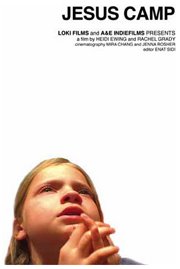 I've come across the trailer for a new documentary, Jesus Camp, from a link at Daily Kos, and have looked up some more information about the film. The film has not yet been released, although it comes out in the US in 8 days (15 September). The trailer portrays in part how American Evangelical Christian fanaticism is mixing religion with militarism and right-wing politics, a brainwashing of American kids that anyone who isn't Christian (and, more likely, anyone who doesn't believe in their type of Christianity) must be defeated.
The following excerpt from a review at IMDB describes the film fairly well:
"Jesus Camp" revolves around a pentecostal minister who hosts a summer camp for children in North Dakota, and the sectarian Christian conservative families who send their children to this camp. Directors Heidi Ewing and Rachel Grady wisely chose to avoid the polemical tone of most politically-motivated films, and instead opt to present a mostly unfiltered glimpse of this odd subculture. But through carefully selected images and the use of talk radio commentary as a framing device, they construct a subtle, yet damning narrative about a religious movement that isolates its children from mainstream culture, indoctrinates them into right-wing causes, and uses them as political props.
At Jesus Camp, the daily activities include standard camp fare such as spelunking and go-karts, but they also include speaking in tongues and smashing coffee mugs emblazoned with the word "government". Children learn that "science doesn't prove anything," and learn to consider themselves part of an Army of God. They are compelled to pledge that they will fight to end abortion. They are even pushed into publicly confessing their impure thoughts, and many of them cry and wail charismatically.
The camp director explains that she admires the way Islamic cultures raise children so devoted they will risk their lives for their faith. When we ultimately see several of the campers being placed by their parents on the steps of the Capitol with tape over their mouths, protesting abortion, the real purpose of this camp is driven home.
But the most touching scenes are the ones where the children are alone, and we see the ways that this indoctrination creeps into the most innocent elements of childhood. 11 year old Tori loves dancing to Christian rock, but frets that it's not always easy to dance for God instead of "dancing for the flesh." On an outing to the bowling alley, 9 year old Rachael feels compelled to walk up to strangers and awkwardly evangelize to them, without being prompted. A roomful of boys telling ghost stories after dark are interrupted by an adult who warns them about stories that don't glorify God.
No doubt some viewers will accuse the filmmakers of the dreaded liberal bias. But this is not a work of fiction, nor is it slanted reporting. These are real people and real events, captured on film. If the evangelical movement comes off badly in this film, the people on screen have no one but themselves to blame.
I've linked to a Youtube presentation of the trailer below (run time: 2:09). Some interesting quotations that I transcribed from the trailer:
"I pledge allegiance to the Christian flag..." (A boy and girl reciting a "pledge.")
"There are two kinds of people in the world: people who love Jesus and people who don't." (An adult woman.)
"I really feel that we're a key generation to Jesus coming back." (Levi O'Brien, a young boy attending the camp.)
"How many of you want to be those who would give up their lives for Jesus?" (An adult man; perhaps the most disturbing part of the trailer as you see perfectly innocent and naive children - especially the blond girl - who jump up and down, waving their hands, and not understanding in the slightest what the man is really asking of them.)
"We're being trained to be God's army." (A second young boy.)
"This means war! This means war! Are you a part of it or not?" (Pastor Becky Fisher, who runs the "Kids on Fire" summer camp, shouting.)
The official website has more information, including two additional videos.
One of the two videos has an interview with Becky Fisher. It's rather sad and typical (and wrong) to see how she views political conflicts in the Middle East (Palestine in particular) as dying "for the cause of Islam." She hopes to instill a fanaticism among the children to the point where they're willing to kill themselves "for the gospel":
"Where should we be putting in our efforts? Where should we be putting our focus? I'll tell you where our enemies are putting it, they're putting it on the kids. They're going into the schools. You go into Palestine, and I can take you to some websites that will absolutely shake you to your foundations and show you photographs of where they're taking their kids to camps like we take our kids to Bible camps, and they're putting hand grenades in their hands, they're teaching them how to put on bomb belts, they're teaching them how to use rifles, they're teaching how to use machine guns; it's no wonder, with that kind of intense training that [garbled], that those young people are ready to kill themselves for the cause of Islam.
"I want to see young people who are as committed to the cause of Jesus Christ as the young people are to the cause of Islam. I want to see them as radically laying down their lives for the gospel as, as they are, uh, over in, in Pakistan, in, in Isreal, and, and Palestine, and all those different places. You know, because we have... excuse me, but we have the truth!"
September 5, 2006
Salaam 'alaikum (peace be unto you).
I posted the following essay originally at Daily Kos, and reposted it at Street Prophets. (Note: My essay has generated a large number of comments at both sites: 55 at Daily Kos and 15 at Street Prophets, to date. Check them out.)
Salaam ‘alaikum (peace be unto you).
PLHeart wrote a recent diary at Daily Kos entitled, “Why I Won’t Become a Muslim.” The diary, unfortunately, is filled with a number of errors and misperceptions about Islam and Muslims; however, I’m not writing today to call PLHeart out. More than enough people have already done that, and it appears that PLHeart him or herself accepts that his or her diary could have been better written.
My problem, as a Muslim, is that I see writings like PLHeart’s all too often. There is a tremendous amount of ignorance about Islam and Muslims held by a huge number of people. Much of the problem, IMO, is caused by a lack of intellectual curiosity and critical thinking. People don’t necessarily want to learn, nor do they want to think deeply about what they’re told. (I’m a college lecturer; I know.) They often take the information they’re given at face value, and frequently react negatively when people tell them otherwise. (This problem affects more than just what people think they know about Islam; for example, this is a common problem with regard to science, especially the debate between evolution and creationism in its various guises.)
The point of this diary, then, is to try to provide some information and correct a few misperceptions about Islam. In particular, I’d like to talk about two of PLHeart’s topics: “tribes” of Islam and conversion (or, as we call it, reversion) to Islam.
In Islam there are no “tribes.” PLHeart’s so-called Sunni, Shi’a and “Wahaddi” (sic) tribes are not, in fact, tribes at all. Of course there are divisions among Muslims, primarily the Sunni and Shi’a, but they are not nearly as major as non-Muslims might think. Should a non-Muslim revert to Islam, there is no determination of whether this man will become Sunni and this woman will become Shi’a. Probably 99% of all Western reverts to Islam become Sunni. This is due to the fact that most masjids in Western countries are Sunni. A Sunni Muslim is one who follows the Sunnah, the tradition of Muhammad (pbuh). The Sunnah, which is made up of the instructions in the Qur’an plus the sayings (ahadith) and actions of the Prophet, is important to Sunnis in that we believe Muhammad (pbuh) was the best living example of how the Qur’an should be applied to our daily lives, bar none.
The Shi’a arose out of the dispute as to who should lead the Muslim community after the death of Muhammad (pbuh). The Sunnis believed that the leader should be elected; the Shi’a believed that people from Muhammad’s (pbuh) family, the Ahl al-Bayt, had the best knowledge about Islam and the Qur’an, and about how Islam should be practiced. Over time, the differences between the Sunni and Shi’a have deepened and there are mixed feelings among the Sunni about the Shi’a (for example, whether to even consider the Shi’a as Muslim), but on a practical basis this is not an issue for the vast majority of Muslims worldwide.
The Wahhabis or, as they prefer, Salafis, are a branch of the Sunnis. I wouldn’t quite call them a school of thought as they themselves reject the idea of being categorized into any of the four Sunni madhhab (school of jurisprudence). The Salafis were started by Muhammad ibn Abd al Wahhab, who was reacting to religious conditions within Arabia during the 1700s. The modern belief among non-Muslims toward the Salafis is that they are puritanical, which is true to a degree as they are trying to rid Islam of any innovations in its practice (which itself is commanded in the Qur’an; e.g., 30:30). However, IMO, the Salafist threat to the West is overblown (as are most Western attitudes toward Islam and Muslims).
PLHeart’s diary, of course, was prompted in part by the recent so-called gunpoint conversions of the two Fox journalists. I’ve been amused at some of the writings from the right who argue that Muslims will consider anyone who has said the shahadah (the statement of belief) to be a Muslim regardless of whether the reversion is coerced or not. Of course, this is completely false. There are a number of conditions attached to the recitation to the shahadah in order for a reversion to be valid, one of which is sincerity: to become a Muslim, one must be sincere in his or her beliefs. One would have to be deluded to believe that any coerced “reversion” would be valid in any way. Likewise, as the Qur’an states:
“Let there be no compulsion in religion: Truth stands out clear from Error: whoever rejects evil and believes in Allah hath grasped the most trustworthy hand-hold, that never breaks. And Allah heareth and knoweth all things.” (2:256)
As Muslims, we know that any compulsion to believe in any religion will not make a conversion valid. A forced conversion will only create resentment in that person’s heart, which could in turn lead to resentment against Allah (swt). The gunpoint “conversion” by the Palestinians is unIslamic; few, if any, Muslims worldwide would consider the Fox journalists to be Muslims today.
While we’re clearing up misconceptions about conversion, let’s look at one other: that Islam is a missionary religion. We are and we aren’t. Yes, we do a type of missionary work, called da’wah, but that is mostly reactive in nature. As many people on PLHeart’s diary commented, people are far more likely to have a Christian come up to them, proselytizing, than a Muslim. (Ironically, just as I was writing this, I had three women from the corner church come up to my door to invite my wife and me to this Sunday’s service.) From my experience, most Christians who proselytize follow a proactive missionary strategy: they approach you directly, talk to you, and ask you to start a conversion process (such as what the ladies did). Muslims tend to follow a passive strategy (if you can call it that): if you approach us with a question, we will try to answer you; if you want to read the Qur’an, we will try to provide you with one. We don’t normally go out onto the streets to approach people. We don’t have missionaries riding around on bicycles. We don’t publish missionary tracts and leave them behind in laundromats. We don’t pass out inflammatory cartoon booklets. If you want to become a Muslim, that’s great. If you don’t, well, that’s fine too. (“Unto you your religion, and unto me my religion.” 109:6) The only Muslim “missionaries” I have ever come across were, in fact, not interested in talking to non-Muslims. Instead, they wanted to meet other Muslims who may be backsliding, so that they could become more active in their faith. For me, I believe the accusation that Islam is a missionary religion is often a case of ignorance and psychological projection.
Wa salaam.
Salaam ‘alaikum (peace be unto you).
PLHeart wrote a recent diary at Daily Kos entitled, “Why I Won’t Become a Muslim.” The diary, unfortunately, is filled with a number of errors and misperceptions about Islam and Muslims; however, I’m not writing today to call PLHeart out. More than enough people have already done that, and it appears that PLHeart him or herself accepts that his or her diary could have been better written.
My problem, as a Muslim, is that I see writings like PLHeart’s all too often. There is a tremendous amount of ignorance about Islam and Muslims held by a huge number of people. Much of the problem, IMO, is caused by a lack of intellectual curiosity and critical thinking. People don’t necessarily want to learn, nor do they want to think deeply about what they’re told. (I’m a college lecturer; I know.) They often take the information they’re given at face value, and frequently react negatively when people tell them otherwise. (This problem affects more than just what people think they know about Islam; for example, this is a common problem with regard to science, especially the debate between evolution and creationism in its various guises.)
The point of this diary, then, is to try to provide some information and correct a few misperceptions about Islam. In particular, I’d like to talk about two of PLHeart’s topics: “tribes” of Islam and conversion (or, as we call it, reversion) to Islam.
In Islam there are no “tribes.” PLHeart’s so-called Sunni, Shi’a and “Wahaddi” (sic) tribes are not, in fact, tribes at all. Of course there are divisions among Muslims, primarily the Sunni and Shi’a, but they are not nearly as major as non-Muslims might think. Should a non-Muslim revert to Islam, there is no determination of whether this man will become Sunni and this woman will become Shi’a. Probably 99% of all Western reverts to Islam become Sunni. This is due to the fact that most masjids in Western countries are Sunni. A Sunni Muslim is one who follows the Sunnah, the tradition of Muhammad (pbuh). The Sunnah, which is made up of the instructions in the Qur’an plus the sayings (ahadith) and actions of the Prophet, is important to Sunnis in that we believe Muhammad (pbuh) was the best living example of how the Qur’an should be applied to our daily lives, bar none.
The Shi’a arose out of the dispute as to who should lead the Muslim community after the death of Muhammad (pbuh). The Sunnis believed that the leader should be elected; the Shi’a believed that people from Muhammad’s (pbuh) family, the Ahl al-Bayt, had the best knowledge about Islam and the Qur’an, and about how Islam should be practiced. Over time, the differences between the Sunni and Shi’a have deepened and there are mixed feelings among the Sunni about the Shi’a (for example, whether to even consider the Shi’a as Muslim), but on a practical basis this is not an issue for the vast majority of Muslims worldwide.
The Wahhabis or, as they prefer, Salafis, are a branch of the Sunnis. I wouldn’t quite call them a school of thought as they themselves reject the idea of being categorized into any of the four Sunni madhhab (school of jurisprudence). The Salafis were started by Muhammad ibn Abd al Wahhab, who was reacting to religious conditions within Arabia during the 1700s. The modern belief among non-Muslims toward the Salafis is that they are puritanical, which is true to a degree as they are trying to rid Islam of any innovations in its practice (which itself is commanded in the Qur’an; e.g., 30:30). However, IMO, the Salafist threat to the West is overblown (as are most Western attitudes toward Islam and Muslims).
PLHeart’s diary, of course, was prompted in part by the recent so-called gunpoint conversions of the two Fox journalists. I’ve been amused at some of the writings from the right who argue that Muslims will consider anyone who has said the shahadah (the statement of belief) to be a Muslim regardless of whether the reversion is coerced or not. Of course, this is completely false. There are a number of conditions attached to the recitation to the shahadah in order for a reversion to be valid, one of which is sincerity: to become a Muslim, one must be sincere in his or her beliefs. One would have to be deluded to believe that any coerced “reversion” would be valid in any way. Likewise, as the Qur’an states:
“Let there be no compulsion in religion: Truth stands out clear from Error: whoever rejects evil and believes in Allah hath grasped the most trustworthy hand-hold, that never breaks. And Allah heareth and knoweth all things.” (2:256)
As Muslims, we know that any compulsion to believe in any religion will not make a conversion valid. A forced conversion will only create resentment in that person’s heart, which could in turn lead to resentment against Allah (swt). The gunpoint “conversion” by the Palestinians is unIslamic; few, if any, Muslims worldwide would consider the Fox journalists to be Muslims today.
While we’re clearing up misconceptions about conversion, let’s look at one other: that Islam is a missionary religion. We are and we aren’t. Yes, we do a type of missionary work, called da’wah, but that is mostly reactive in nature. As many people on PLHeart’s diary commented, people are far more likely to have a Christian come up to them, proselytizing, than a Muslim. (Ironically, just as I was writing this, I had three women from the corner church come up to my door to invite my wife and me to this Sunday’s service.) From my experience, most Christians who proselytize follow a proactive missionary strategy: they approach you directly, talk to you, and ask you to start a conversion process (such as what the ladies did). Muslims tend to follow a passive strategy (if you can call it that): if you approach us with a question, we will try to answer you; if you want to read the Qur’an, we will try to provide you with one. We don’t normally go out onto the streets to approach people. We don’t have missionaries riding around on bicycles. We don’t publish missionary tracts and leave them behind in laundromats. We don’t pass out inflammatory cartoon booklets. If you want to become a Muslim, that’s great. If you don’t, well, that’s fine too. (“Unto you your religion, and unto me my religion.” 109:6) The only Muslim “missionaries” I have ever come across were, in fact, not interested in talking to non-Muslims. Instead, they wanted to meet other Muslims who may be backsliding, so that they could become more active in their faith. For me, I believe the accusation that Islam is a missionary religion is often a case of ignorance and psychological projection.
Wa salaam.
September 1, 2006
Malaguena
Someone was looking for Malaguena and gave me a hit when they visited my recent Velvet Knights post (the second video of four). Malaguena is one of my all-time favorite drum corps songs, and so I thought I'd add a few more videos that focus on this particular song. The first is the 1988 Madison Scouts (run time: 7:17), the second is the 2003 Cadets version (run time: 4:51), and the third is Blast's version (run time: 6:58). Now, if only I could find a CD here of Stan Kenton's recording...
August 30, 2006
Lie by Lie: Chronicle of a War Foretold: August 1990 to March 2003
Lie by Lie: Chronicle of a War Foretold: August 1990 to March 2003
The first drafts of history are fragmentary. Important revelations arrive late, and out of order. In this timeline, we’ve assembled the history of the Iraq War to create a resource we hope will help resolve open questions of the Bush era. What did our leaders know and when did they know it? And, perhaps just as important, what red flags did we miss, and how could we have missed them? This is the first installment in our Iraq War timeline project.
"Lie by Lie" is a massive Flash database of events leading up to the Iraq War. The "mechanism" for using this database is a little unwieldy and requires a "fine touch," but the amount of information in it already is enormous, and should be of good use for trying to understand recent US history. Check it out!
The first drafts of history are fragmentary. Important revelations arrive late, and out of order. In this timeline, we’ve assembled the history of the Iraq War to create a resource we hope will help resolve open questions of the Bush era. What did our leaders know and when did they know it? And, perhaps just as important, what red flags did we miss, and how could we have missed them? This is the first installment in our Iraq War timeline project.
"Lie by Lie" is a massive Flash database of events leading up to the Iraq War. The "mechanism" for using this database is a little unwieldy and requires a "fine touch," but the amount of information in it already is enormous, and should be of good use for trying to understand recent US history. Check it out!
Cosmophilia: Islamic Art from the David Collection, Copenhagen
The McMullen Museum of Art at Boston College is presenting an exhibit of Islamic Art called Cosmophilia, from the David Collection, Copenhagen, from September 1 through December 31, 2006. (Note: Details from each of the following photos can best be seen at the McMullen website. Click on the category titles to go to the individual webpages.)
Cosmophilia
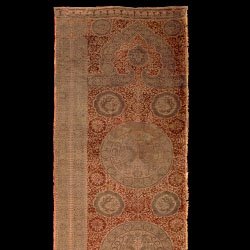 Cosmophilia (literally "love of ornament") is an exhibition comprised of 123 of the finest examples of Islamic art from the C. L. David Collection in Copenhagen, Denmark. "Islamic art," a term coined by Orientalists, refers not only to the arts made for the faith of Islam, but also to all arts created in lands where Islam was the principal religion. Ornament is one of its most characteristic features, as can be seen from the objects in this exhibition. The works presented incorporate the full array of Islamic art from its origins to modern times, representing vast spans of time (seventh-nineteenth centuries), space (Western Europe to East Asia), and media (textiles; ceramics; metalwares; carved ivory, wood, rock-crystal and stone; parchment; and paper). Rather than the typical organization by chronology, place of origin, function or technique, these works are presented visually to reveal how artisans in the Islamic lands explored four major themes of decoration.
Picture's Caption: Fragment of a Silk lampas, 14th century, Central Asia or China, silk and gilded paper lamella both spun around silk and woven flat, 228 x 63.5 cm., 40/1997
Figures
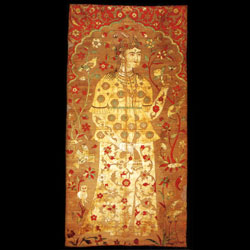 Many people think that Islam prohibits figural representation, but this is not true. The Koran, the Muslim scripture, bans idolatry, or the worship of images, so images are not found in mosques and other religious settings. But many Muslims—like people everywhere—enjoyed pictures of people and animals in their everyday lives. Sometimes figures are shown realistically, as in this beautiful velvet from seventeenth-century Iran or India, inwhich an elegant lady sniffs a flower in a garden surrounded by birds and animals. in other cases, the figures are more abstract, making it possible to interpret the representation in several different ways.
Picture's Caption: Velvet with lady in a niche, 17th century, India or Iran. Silk and metal lamella spun around silk, 143 x 69 cm. 37/1995
Writing
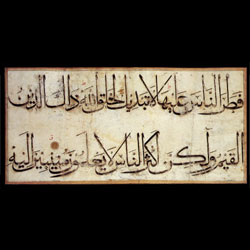 The central miracle in Islam is the Koran, which Muslims believe was revealed in Arabic to the Prophet Muhammad in early seventh-century Arabia. Reverence for the word therefore became a primary theme of religious art, as artists endeavored to make the physical presentation of God's word as beautiful as its content. These two lines come from one of the largest manuscripts of the Koran ever made, a loose-leaf copy produced about 1400 for the congregational mosque built by the warlord Timur at Samarkand in Central Asia. Artists everywhere used verses from the Koran to decorate Islamic art and architecture, and the appreciation of beautiful writing led them to exploit the decorative potential of Arabic script by developing many styles to use in different media and contexts.
Picture's Caption: Leaf from a large Koran manuscript written in Muhaqqaq script, 1400-1405, Afghanistan. Ink and gold on paper, 45 x 98 cm. 20/1987
Geometry
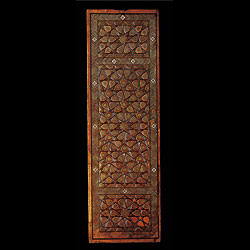 Artisans in the Islamic lands expanded the pre-Islamic repertory of geometric designs to create stunning compositions based on strapwork and tile patterns of triangles, squares, polygons, stars, and other regular forms. Many designs start from 45° or 60° grids that yield patterns of 8-pointed stars and hexagons, while others, such as this panel from a pair of seventeenth-century Iranian doors, are based on an extremely complex arrangement of pentagons and ten-pointed stars. Each individual element is made up of hundreds of minute rods of wood, bone, and metal that were glued together in other geometric patterns and then sliced to form tiles. Mathematicians in the Islamic lands were extremely sophisticated (algebra and algorithms, for example, were brought to the West by Muslim scientists), but artisans seem to have worked out most of these designs—even the most complex examples like this one—using traditional "tricks of the trade" without recourse to higher mathematics.
Picture's Caption: One side of a double door, 17th century, Iran. Several types of wood; patterns inlaid with brass, ivory, and wood, 242.5 x 74 x 8.7 cm. 35/2000
Vegetation
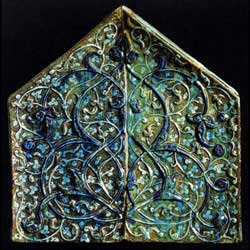 Artisans in the Islamic lands also inherited a rich tradition of decoration with vines, stems, leaves, and flowers. Vegetal ornament was used regularly and consistently in all the arts throughout the region. The depiction of lush vegetation and verdant gardens was undoubtedly attractive to the inhabitants of this dry and often dusty part of the world, and these designs may also have recalled the Garden of Paradise promised to Muslims in the Koran. Sometimes artists depicted gardens realistically, but their most distinctive achievement was the transformation of naturalistic vegetal ornament into the arabesque, an abstracted form in which plants and leaves grow according to the laws of geometry rather than nature. In these large tiles from the hood of a fourteenth-century Persian mihrab (the niche in the Mecca-facing wall of a mosque), for example, the vines and leaves grow in choreographed symmetry from a central source.
Picture's Caption: Mihrab tile, late 13th century, Kashan, Iran. Fritware, cast in two parts and painted in blue and turquoise in, and in luster over, an opaque white glaze, 76 x 74 cm. 1/1968
Hybrids
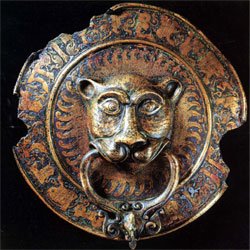 Artisans often combined these four themes within single works of art. This stunning doorknocker, probably made in southern Italy around the year 1100, for example, takes the shape of a lion's head which grasps a cock-headed ring in its maw. His mane is geometricized into a flame-like halo, and the whole composition is surrounded by an Arabic inscription set on a vegetal ground. The inscription, written as if the lion itself were speaking, states "I attest that there is no god but God and that Muhammad is His prophet." The inscription is thus a visual pun, written so that when the cock's head strikes the plate, it is as if the lion were roaring forth, attesting to his faith in Islam.
Picture's Caption: Lion-headed doorknocker, 11th century, Southern Italy. Cast and engraved bronze, partly inlaid with niello, 44.3 cm. 50/2000
Curated by Sheila S. Blair and Jonathan M. Bloom, Cosmophilia was organized by the McMullen Museum of Art, Boston College in collaboration with the David Collection, Copenhagen. Major support has been provided by the Calderwood Charitable Foundation, the National Endowment for the Arts, and the Patrons of the McMullen Museum. The exhibition is dedicated to Norma Jean and the late Stanford Calderwood, who did so much to foster the study of Islamic art at Boston College. This exhibition is supported by an indemnity from the Federal Council on the Arts and the Humanities.
Cosmophilia
 Cosmophilia (literally "love of ornament") is an exhibition comprised of 123 of the finest examples of Islamic art from the C. L. David Collection in Copenhagen, Denmark. "Islamic art," a term coined by Orientalists, refers not only to the arts made for the faith of Islam, but also to all arts created in lands where Islam was the principal religion. Ornament is one of its most characteristic features, as can be seen from the objects in this exhibition. The works presented incorporate the full array of Islamic art from its origins to modern times, representing vast spans of time (seventh-nineteenth centuries), space (Western Europe to East Asia), and media (textiles; ceramics; metalwares; carved ivory, wood, rock-crystal and stone; parchment; and paper). Rather than the typical organization by chronology, place of origin, function or technique, these works are presented visually to reveal how artisans in the Islamic lands explored four major themes of decoration.
Picture's Caption: Fragment of a Silk lampas, 14th century, Central Asia or China, silk and gilded paper lamella both spun around silk and woven flat, 228 x 63.5 cm., 40/1997
Figures
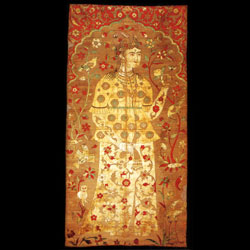 Many people think that Islam prohibits figural representation, but this is not true. The Koran, the Muslim scripture, bans idolatry, or the worship of images, so images are not found in mosques and other religious settings. But many Muslims—like people everywhere—enjoyed pictures of people and animals in their everyday lives. Sometimes figures are shown realistically, as in this beautiful velvet from seventeenth-century Iran or India, inwhich an elegant lady sniffs a flower in a garden surrounded by birds and animals. in other cases, the figures are more abstract, making it possible to interpret the representation in several different ways.
Picture's Caption: Velvet with lady in a niche, 17th century, India or Iran. Silk and metal lamella spun around silk, 143 x 69 cm. 37/1995
Writing
 The central miracle in Islam is the Koran, which Muslims believe was revealed in Arabic to the Prophet Muhammad in early seventh-century Arabia. Reverence for the word therefore became a primary theme of religious art, as artists endeavored to make the physical presentation of God's word as beautiful as its content. These two lines come from one of the largest manuscripts of the Koran ever made, a loose-leaf copy produced about 1400 for the congregational mosque built by the warlord Timur at Samarkand in Central Asia. Artists everywhere used verses from the Koran to decorate Islamic art and architecture, and the appreciation of beautiful writing led them to exploit the decorative potential of Arabic script by developing many styles to use in different media and contexts.
Picture's Caption: Leaf from a large Koran manuscript written in Muhaqqaq script, 1400-1405, Afghanistan. Ink and gold on paper, 45 x 98 cm. 20/1987
Geometry
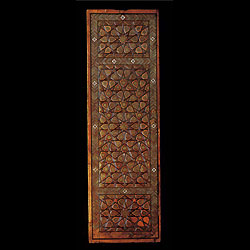 Artisans in the Islamic lands expanded the pre-Islamic repertory of geometric designs to create stunning compositions based on strapwork and tile patterns of triangles, squares, polygons, stars, and other regular forms. Many designs start from 45° or 60° grids that yield patterns of 8-pointed stars and hexagons, while others, such as this panel from a pair of seventeenth-century Iranian doors, are based on an extremely complex arrangement of pentagons and ten-pointed stars. Each individual element is made up of hundreds of minute rods of wood, bone, and metal that were glued together in other geometric patterns and then sliced to form tiles. Mathematicians in the Islamic lands were extremely sophisticated (algebra and algorithms, for example, were brought to the West by Muslim scientists), but artisans seem to have worked out most of these designs—even the most complex examples like this one—using traditional "tricks of the trade" without recourse to higher mathematics.
Picture's Caption: One side of a double door, 17th century, Iran. Several types of wood; patterns inlaid with brass, ivory, and wood, 242.5 x 74 x 8.7 cm. 35/2000
Vegetation
 Artisans in the Islamic lands also inherited a rich tradition of decoration with vines, stems, leaves, and flowers. Vegetal ornament was used regularly and consistently in all the arts throughout the region. The depiction of lush vegetation and verdant gardens was undoubtedly attractive to the inhabitants of this dry and often dusty part of the world, and these designs may also have recalled the Garden of Paradise promised to Muslims in the Koran. Sometimes artists depicted gardens realistically, but their most distinctive achievement was the transformation of naturalistic vegetal ornament into the arabesque, an abstracted form in which plants and leaves grow according to the laws of geometry rather than nature. In these large tiles from the hood of a fourteenth-century Persian mihrab (the niche in the Mecca-facing wall of a mosque), for example, the vines and leaves grow in choreographed symmetry from a central source.
Picture's Caption: Mihrab tile, late 13th century, Kashan, Iran. Fritware, cast in two parts and painted in blue and turquoise in, and in luster over, an opaque white glaze, 76 x 74 cm. 1/1968
Hybrids
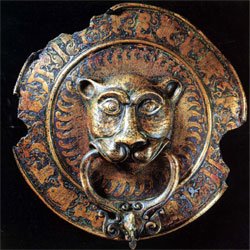 Artisans often combined these four themes within single works of art. This stunning doorknocker, probably made in southern Italy around the year 1100, for example, takes the shape of a lion's head which grasps a cock-headed ring in its maw. His mane is geometricized into a flame-like halo, and the whole composition is surrounded by an Arabic inscription set on a vegetal ground. The inscription, written as if the lion itself were speaking, states "I attest that there is no god but God and that Muhammad is His prophet." The inscription is thus a visual pun, written so that when the cock's head strikes the plate, it is as if the lion were roaring forth, attesting to his faith in Islam.
Picture's Caption: Lion-headed doorknocker, 11th century, Southern Italy. Cast and engraved bronze, partly inlaid with niello, 44.3 cm. 50/2000
Curated by Sheila S. Blair and Jonathan M. Bloom, Cosmophilia was organized by the McMullen Museum of Art, Boston College in collaboration with the David Collection, Copenhagen. Major support has been provided by the Calderwood Charitable Foundation, the National Endowment for the Arts, and the Patrons of the McMullen Museum. The exhibition is dedicated to Norma Jean and the late Stanford Calderwood, who did so much to foster the study of Islamic art at Boston College. This exhibition is supported by an indemnity from the Federal Council on the Arts and the Humanities.
August 26, 2006
Maynard Ferguson: 1928 - 2006
 From Allah (swt) do we come, and unto Allah do we return. I'm sorry to hear that Maynard Ferguson has passed away. He was 78.
For those of us in the drum corps activity, Maynard was a major inspiration. My corps in 1978, the Empire State Express, played Maynard's arrangement of "Scheherazade," from the "New Vintage" album. It's a great song, and very typical of Maynard's style, with the elongated, park-and-blow double high C. On the recording, Maynard holds that double high C for - oh - 45 seconds or so. Our lead soprano could only hold it for about 20 seconds at the most.
 Theories abounded as to how Maynard could hold the note for so long, the most popular being "circular breathing," where Maynard could somehow both breathe in and play the trumpet simultaneously. The article linked above suggests that Maynard credited yoga for his ability to sustain his notes.
Maynard: You will be missed.
What is Islam?
And so I write about our need to do da'wah intelligently and I come across this video, which is very nicely done and provides basic answers to non-Muslims about Islam. Run time: 4:54.
Willful Ignorance About Islam
Izzy Mo had an interesting comment on her blog: "Yesterday, a coworker asked me if there was a difference between Islam and Muslims. Really, she did. She thought that Islam was something different from what Muslims practice. It was then when I realized just how much work we have to do. I forget that there are millions of Americans who don’t know the basics of our deen. And you’re a genius if you know that Muslims don’t eat pork."
The fact of the matter is that everything written above is true. Milady and I stumbled upon a short Youtube video (run time: 4:37) by the Muslim comedian Mo Amer who asked a number of Americans outside a Houston comedy club questions about Islam and Arabs. Even Izzy's comment, "...you're a genius if you know that Muslims don't eat pork" is correct to a degree: in the video, five of seven respondants got the question right, but one answered "beef" and another "cow."
I've had my own experiences with people who are ignorant about Islam although, thankfully, incidents like Izzy's aren't too common here in S'pore where the Muslim community has been living for centuries and the non-Muslims are relatively knowledgeable. Most of my experiences have been on the Internet (Beliefnet in particular, when I used to be a regular there).
I do agree that there's a strong need to educate people around the world (not just Americans) about Islam. The problem, IMO, is that many people have hardened attitudes about Islam that are wrong. Not only do these people not have open minds about Islam, but they tend to have both a shallow understanding about Islam and Muslims while being argumentative (the "insta-expert" syndrome). This past week, I came across a post that seems to sum up the depths to which Islamophobes sink. This clown says, "Oh, yes, we're willfully ignorant about Islam," to which I would agree, but his solution is that people should read the various websites he's linked to, all of which are stridently Islamophobic (the usual suspects, most of which should be familiar to my Muslim readers and none of which are deserving of additional attention). To the clown I would say, "Yes, you and people who think like you are willfully ignorant of Islam, very much so, but your sources of information about Islam will only make you more ignorant, not less." (Not that I think the likes of him would care.)
And so, while I agree with Izzy when she says, "...we need some dawah power", we must also do our da'wah intelligently, applying the principles of advertising when we can*, so as to counter the propaganda of the "willfully ignorant" and change some attitudes, insha'allah.
* For who has the most experience in trying to counter negative attitudes publicly than advertisers?
The fact of the matter is that everything written above is true. Milady and I stumbled upon a short Youtube video (run time: 4:37) by the Muslim comedian Mo Amer who asked a number of Americans outside a Houston comedy club questions about Islam and Arabs. Even Izzy's comment, "...you're a genius if you know that Muslims don't eat pork" is correct to a degree: in the video, five of seven respondants got the question right, but one answered "beef" and another "cow."
I've had my own experiences with people who are ignorant about Islam although, thankfully, incidents like Izzy's aren't too common here in S'pore where the Muslim community has been living for centuries and the non-Muslims are relatively knowledgeable. Most of my experiences have been on the Internet (Beliefnet in particular, when I used to be a regular there).
I do agree that there's a strong need to educate people around the world (not just Americans) about Islam. The problem, IMO, is that many people have hardened attitudes about Islam that are wrong. Not only do these people not have open minds about Islam, but they tend to have both a shallow understanding about Islam and Muslims while being argumentative (the "insta-expert" syndrome). This past week, I came across a post that seems to sum up the depths to which Islamophobes sink. This clown says, "Oh, yes, we're willfully ignorant about Islam," to which I would agree, but his solution is that people should read the various websites he's linked to, all of which are stridently Islamophobic (the usual suspects, most of which should be familiar to my Muslim readers and none of which are deserving of additional attention). To the clown I would say, "Yes, you and people who think like you are willfully ignorant of Islam, very much so, but your sources of information about Islam will only make you more ignorant, not less." (Not that I think the likes of him would care.)
And so, while I agree with Izzy when she says, "...we need some dawah power", we must also do our da'wah intelligently, applying the principles of advertising when we can*, so as to counter the propaganda of the "willfully ignorant" and change some attitudes, insha'allah.
* For who has the most experience in trying to counter negative attitudes publicly than advertisers?
August 17, 2006
Adab
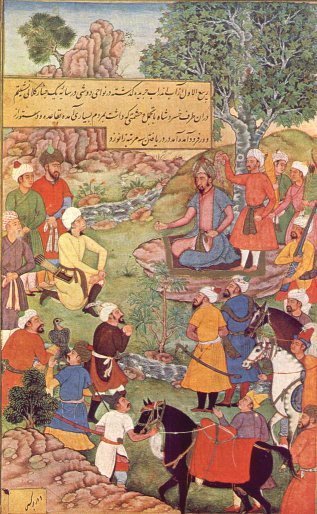 'Abd al-Hamid ibn Yahya al-Kitab, an Umayyad official credited with the creation of this genre, defined its aims as follows:
"Cultivate the Arabic language so that you may speak correctly; develop a handsome script which will add lustre to your writings; learn the poetry of the Arabs by heart; familiarize yourself with unusual ideas and expressions; read the history of the Arabs and Persians, and remember their great deeds."
-- Paul Lunde, Islam: A Brief History, p. 88
August 14, 2006
1988 Velvet Knights (2 Cool; in 4 parts)
Been wandering around Youtube again and came across a video of the 1988 Velvet Knights at DCI (held in KC that year). One of the benefits of my having started Copper Star (the senior corps) back in '98 was getting to meet and know a bunch of guys who had marched in VK over the years.
This particular video has been cut up into four parts (the songs and run times are below), but all four make up the entire show. Highlights include the bull fight during Malaguena (I've been told that Copper Star alumnus Sean C. was the back end of the bull), the "Pee Wee Herman" bicycle ride during the Cannibal Fun drum solo and, of course, the bikini girl popping out of the hat at the end of the show. Sorry, no shark this year. :P
Magical Mystery Tour - Part II:
Part 1: Magical Mystery Tour * Zorba The Greek (run time: 2:04)
Part 2: Malaguena (run time: 3:39)
Part 3: Cannibal Fun Drum Solo (run time: 2:37)
Part 4: There's No Place Like Home * America The Beautiful * Yankee Doodle Dandy * You're a Grand Old Flag (run time: 2:52)
This particular video has been cut up into four parts (the songs and run times are below), but all four make up the entire show. Highlights include the bull fight during Malaguena (I've been told that Copper Star alumnus Sean C. was the back end of the bull), the "Pee Wee Herman" bicycle ride during the Cannibal Fun drum solo and, of course, the bikini girl popping out of the hat at the end of the show. Sorry, no shark this year. :P
Magical Mystery Tour - Part II:
Part 1: Magical Mystery Tour * Zorba The Greek (run time: 2:04)
Part 2: Malaguena (run time: 3:39)
Part 3: Cannibal Fun Drum Solo (run time: 2:37)
Part 4: There's No Place Like Home * America The Beautiful * Yankee Doodle Dandy * You're a Grand Old Flag (run time: 2:52)
Ahree Lee: Me
This is an interesting short film (run time: 1:08) of an Asian woman (Korean?) who took one photograph of herself every day for three years, beginning on 1 November 2001. It's worth running through several times to watch various aspects of herself change over time, in particular her hair, her lips (whether she's got lipstick on or not), and her glasses.
Update: I've discovered that the film playing on Youtube is the "short" version. The full length version (run time: 3:00) of "Me" can be found at atomfilms.com. To be honest, there's little difference between the two versions, except for two additional minutes of flickering Ahree's. Trivial factoid: One second's worth of film has about seven day's worth of photographs (another hint that the Youtube version of this film only shows one year out of the three that have been filmed).
Ahree's website also has another short film worth watching: Everyone. "This counterpart to Me, comprising images of everyone I could convince to let me take their picture in the fall of 2001, fleshes out the other end of the spectrum of homogeneity to heterogeneity."
Update: I've discovered that the film playing on Youtube is the "short" version. The full length version (run time: 3:00) of "Me" can be found at atomfilms.com. To be honest, there's little difference between the two versions, except for two additional minutes of flickering Ahree's. Trivial factoid: One second's worth of film has about seven day's worth of photographs (another hint that the Youtube version of this film only shows one year out of the three that have been filmed).
Ahree's website also has another short film worth watching: Everyone. "This counterpart to Me, comprising images of everyone I could convince to let me take their picture in the fall of 2001, fleshes out the other end of the spectrum of homogeneity to heterogeneity."
August 12, 2006
1974 Madison Scouts (DCI Prelims)
I'm quite surprised - and very pleased - to find this show on youtube. Madison fielded a great corps that year, but - alas - came in 2nd at DCI. (One of my good friends, Garry P., played with the 1st place Santa Clara Vanguard that year.) Still, this was the corps I was rooting for in '74 (and '75). DCI was held that year at Cornell University in Ithaca, New York, 40 miles from home. So, yes, I'm in the crowd ... somewhere. :) (In the summer of '74, I had marched my first year in the Mark Twain Cadets at the ripe old age of ... 12. :) )
Repertoire: Ballet in Brass * Bond Street * God Bless the Child * Slaughter on 10th Avenue (from On Your Toes) * Brian's Song. Run time: 13:04.
Repertoire: Ballet in Brass * Bond Street * God Bless the Child * Slaughter on 10th Avenue (from On Your Toes) * Brian's Song. Run time: 13:04.
August 11, 2006

"I'm late, I'm late for a very important date..."
 This story just cracked me up. Yeah, lady, all those speeding tickets are just so much garbage. Throw them away; don't worry, be happy. :) And, uh, make sure you don't smash into any cars as your roar back and forth on the freeway! From the August 11 Arizona Republic:
A woman who was caught 69 times by Scottsdale speed cameras since March told detectives she threw the tickets away because she didn't think anything could happen to her. Now, she faces jail and $11,000 in fines.
Five of the citations issued to Francesca Cisneros, 32, of Chandler, were criminal speeding violations. She also was caught once by a red-light camera, and she faces two counts of driving on a suspended license.
Cisneros told officers she speeds because she often is late for meetings, Scottsdale police Sgt. Mark Clark said.
All but five of her 69 speeding tickets were on Loop 101; her top speed was 86 mph. The unpaid tickets are a Scottsdale record.
August 10, 2006
On Da'wah in the West
The following is a comment I wrote to Emmanuel, a Catholic Malaysian blogger, who was responding to a post written by MENJ regarding South Korean missionaries who are being expelled from Afghanistan. After posting this comment, I thought I would cross-post it onto this blog and some others.
Emmanuel: Da’wah, as practiced by Muslims in the West, is almost invisible. I do not say this negatively, merely as a statement of fact. In the US (at least), da’wah to non-Muslims is rarely done face-to-face, unlike, say, the Mormons or JWs. We don’t ride around the neighborhood on bicycles in white shirts and dark ties, asking people to convert. We also don’t pass out cartoon tracts like Jack Chick’s or booklets like the JW’s, leaving them lying around for people to read (although I will say I don’t think badly of the JW booklets). In fact, the only Muslim da’wah group I’ve ever met members of face-to-face were only interested in meeting other Muslims, trying to get lax brothers and sisters to become more devout. Certainly no one ever came up to me and asked me to become Muslim, which is more than the Christians (including some members of my family) can say.
I see by your blog that you’re Catholic (as I was, once, long ago). Muslims are like Catholics in that neither group really needs to do da’wah. If someone is interested in Catholicism, you try to answer their questions and perhaps provide a Bible to help them understand the religion or direct them to other people who are more knowledgeable. That’s how it is in Islam. For many Muslims in the West, the greatest source of Da’wah is the Qur’an itself. It was my study of the Qur’an over a period of four years that ultimately led to my becoming a Muslim. A lot of questions were answered for me by people on the internet, whether in the form of reading articles or by sending e-mails to ask peoplle questions, but in all cases it was I who made the initial contact.
But far too many Christian missionaries use underhanded tactics in trying to convert people. Unlike MENJ, I do think it is constructive, both in the long- and short-term, to ban missionaries. Read the famous article, The Stealth Crusade, published in Mother Jones magazine four years ago, and you’ll begin to understand some of our concerns.
Emmanuel: Da’wah, as practiced by Muslims in the West, is almost invisible. I do not say this negatively, merely as a statement of fact. In the US (at least), da’wah to non-Muslims is rarely done face-to-face, unlike, say, the Mormons or JWs. We don’t ride around the neighborhood on bicycles in white shirts and dark ties, asking people to convert. We also don’t pass out cartoon tracts like Jack Chick’s or booklets like the JW’s, leaving them lying around for people to read (although I will say I don’t think badly of the JW booklets). In fact, the only Muslim da’wah group I’ve ever met members of face-to-face were only interested in meeting other Muslims, trying to get lax brothers and sisters to become more devout. Certainly no one ever came up to me and asked me to become Muslim, which is more than the Christians (including some members of my family) can say.
I see by your blog that you’re Catholic (as I was, once, long ago). Muslims are like Catholics in that neither group really needs to do da’wah. If someone is interested in Catholicism, you try to answer their questions and perhaps provide a Bible to help them understand the religion or direct them to other people who are more knowledgeable. That’s how it is in Islam. For many Muslims in the West, the greatest source of Da’wah is the Qur’an itself. It was my study of the Qur’an over a period of four years that ultimately led to my becoming a Muslim. A lot of questions were answered for me by people on the internet, whether in the form of reading articles or by sending e-mails to ask peoplle questions, but in all cases it was I who made the initial contact.
But far too many Christian missionaries use underhanded tactics in trying to convert people. Unlike MENJ, I do think it is constructive, both in the long- and short-term, to ban missionaries. Read the famous article, The Stealth Crusade, published in Mother Jones magazine four years ago, and you’ll begin to understand some of our concerns.
August 9, 2006
Happy B-day, Sg!
 While I'm working on blogger, I should also like to say, "Happy 41st Birthday, Singapore, from one of your PRs!" :) Today is National Day.
Juan Cole on the Misnomer of "Islamic Fascism"
Juan Cole, whom you should read if you don't already, has been on a roll since the crisis in Lebanon began. His latest post, Bush, Islamic Fascism and the Christians of Jounieh, has a very good passage about how Bush's reference to "Islamic fascism" is both incorrect and offensive. First, some background:
Bush is on vacation, his favorite place to be during a major crisis. The August retreat is the only open admission he makes that Cheney and Rumsfeld are actually running the country, and he just doesn't need to be in his office. The only difference between his stonewalling of Lebanon and the way he let New Orleans drown is that he has put away the banjo this summer, at least in public view. He had someone tie a necktie on him and stopped manically clearing brush for long enough to come out with Condi and hold a press conference. He lied, saying that no one wants to see the violence continue. He wants to see the violence continue. Otherwise he would insist on a ceasefire. You see, if you don't have a ceasefire, the violence continues. If you oppose a ceasefire, you are saying you want the violence to continue. He does.
Then he tried to explain the war in Lebanon by saying this,
'They try to spread their jihadist message -- a message I call, it's totalitarian in nature -- Islamic radicalism, Islamic fascism, they try to spread it as well by taking the attack to those of us who love freedom.'
...
...[T]here are other problems with what Bush said. He contrasted "Islamic fascism" to "democracy," presumably a reference to the Lebanese Hizbullah.
This point is incorrect and offensive for many reasons.
It is a misuse of the word "Islamic." "Islamic" has to do with the ideals and achievements of the Muslims and the Muslim religion. Thus, we speak of Islamic art. We speak of Islamic ethics.
There can be Muslim fascists, just as there can be Christian fascists (and were, in Spain, Italy and Germany, and parts of Central and South America; the Spanish fascists and the Argentinian ones, e.g., were adopted by the United States government as close allies.)
But there cannot be "Islamic" fascists, because the Islamic religion enshrines values that are incompatible with fascism.
Fascism is not even a very good description of the ideology of most Muslim fundamentalists. Most fascism in the Middle East has been secular in character, as with Saddam Hussein's Baath Party. Fascism involves extreme nationalism and most often racism. Muslim fundamentalist movements reject the nation-state as their primary loyalty and reject race as a basis for political action or social discrimination. Fascists exalt the state above individual rights or the rule of law. Muslim fundamentalists exalt Islamic law above the utilitarian interests of the state. Fascism exalts youth and a master race above the old and the "inferior" races. Muslim fundamentalists would never speak this way. Fascism glorifies "war as an end in itself and victory as the determinant of truth and worthiness." Muslim fundamentalists view holy war as a ritual with precise conditions and laws governing its conduct. It is not considered an end in itself.
Another excellent post by Dr. Cole is One Ring to Rule Them All, in which he speculates that the US-Israeli war on Lebanon is merely phase I of a larger strategy to deprive Asian economies (China and India in particular) of access to middle eastern oil in favor of the American economy:
Destroy Lebanon, and destroy Hizbullah, and you reduce Iran's strategic depth. Destroy the Iranian nuclear program and you leave it helpless and vulnerable to having done to it what the Israelis did to Lebanon. You leave it vulnerable to regime change, and a dragooning of Iran back into the US sphere of influence, denying it to China and assuring its 500 tcf of natural gas to US corporations. You also politically reorient the entire Gulf, with both Saddam and Khamenei gone, toward the United States. Voila, you avoid peak oil problems in the US until a technological fix can be found, and you avoid a situation where China and India have special access to Iran and the Gulf.
This one little paragraph is only a tiny bit of the larger argument; I suggest you read the entire post. (The whole post has created 81 comments to date - some of which have their own excellent analyses - which is about 3-4 times the number that Dr. Cole normally receives on any given post that he writes.)
Bush is on vacation, his favorite place to be during a major crisis. The August retreat is the only open admission he makes that Cheney and Rumsfeld are actually running the country, and he just doesn't need to be in his office. The only difference between his stonewalling of Lebanon and the way he let New Orleans drown is that he has put away the banjo this summer, at least in public view. He had someone tie a necktie on him and stopped manically clearing brush for long enough to come out with Condi and hold a press conference. He lied, saying that no one wants to see the violence continue. He wants to see the violence continue. Otherwise he would insist on a ceasefire. You see, if you don't have a ceasefire, the violence continues. If you oppose a ceasefire, you are saying you want the violence to continue. He does.
Then he tried to explain the war in Lebanon by saying this,
'They try to spread their jihadist message -- a message I call, it's totalitarian in nature -- Islamic radicalism, Islamic fascism, they try to spread it as well by taking the attack to those of us who love freedom.'
...
...[T]here are other problems with what Bush said. He contrasted "Islamic fascism" to "democracy," presumably a reference to the Lebanese Hizbullah.
This point is incorrect and offensive for many reasons.
It is a misuse of the word "Islamic." "Islamic" has to do with the ideals and achievements of the Muslims and the Muslim religion. Thus, we speak of Islamic art. We speak of Islamic ethics.
There can be Muslim fascists, just as there can be Christian fascists (and were, in Spain, Italy and Germany, and parts of Central and South America; the Spanish fascists and the Argentinian ones, e.g., were adopted by the United States government as close allies.)
But there cannot be "Islamic" fascists, because the Islamic religion enshrines values that are incompatible with fascism.
Fascism is not even a very good description of the ideology of most Muslim fundamentalists. Most fascism in the Middle East has been secular in character, as with Saddam Hussein's Baath Party. Fascism involves extreme nationalism and most often racism. Muslim fundamentalist movements reject the nation-state as their primary loyalty and reject race as a basis for political action or social discrimination. Fascists exalt the state above individual rights or the rule of law. Muslim fundamentalists exalt Islamic law above the utilitarian interests of the state. Fascism exalts youth and a master race above the old and the "inferior" races. Muslim fundamentalists would never speak this way. Fascism glorifies "war as an end in itself and victory as the determinant of truth and worthiness." Muslim fundamentalists view holy war as a ritual with precise conditions and laws governing its conduct. It is not considered an end in itself.
Another excellent post by Dr. Cole is One Ring to Rule Them All, in which he speculates that the US-Israeli war on Lebanon is merely phase I of a larger strategy to deprive Asian economies (China and India in particular) of access to middle eastern oil in favor of the American economy:
Destroy Lebanon, and destroy Hizbullah, and you reduce Iran's strategic depth. Destroy the Iranian nuclear program and you leave it helpless and vulnerable to having done to it what the Israelis did to Lebanon. You leave it vulnerable to regime change, and a dragooning of Iran back into the US sphere of influence, denying it to China and assuring its 500 tcf of natural gas to US corporations. You also politically reorient the entire Gulf, with both Saddam and Khamenei gone, toward the United States. Voila, you avoid peak oil problems in the US until a technological fix can be found, and you avoid a situation where China and India have special access to Iran and the Gulf.
This one little paragraph is only a tiny bit of the larger argument; I suggest you read the entire post. (The whole post has created 81 comments to date - some of which have their own excellent analyses - which is about 3-4 times the number that Dr. Cole normally receives on any given post that he writes.)
August 6, 2006
It's the End of the World as We Know It...
And I feel fine.
Milady and I had a good laugh over the following Daily Show clip on the apocalypse (run time: 5:15):
This clip made me wonder, the American news industry has been stupid for a long time, sure, but just how completely retarded has it gotten since I left home? Then again, when I read about what's going on at the White House...
Asked what "types of people" have offered the White House advice on the Middle East, [White House Press Secretary Tony] Snow said, "Again, at this point, I really don't want to do it." Asked if "religious leaders" have been part of these meetings, Snow said, "Again, I'm just not going to go any further."
Why all the secrecy? Maybe it has something to do with the fact that White House recently invited a Christian apocalyptic fiction writer to chat about biblical prophecy.
The Washington Post's Dan Froomkin spoke with Joel C. Rosenberg — who recently told CNN that the rapture may be near and it'd be a good idea for people to start taking care of unfinished business — who explained that he was invited last year to "speak to a 'couple dozen' White House aides in the Old Executive Office Building — and has stayed in touch with several of them since."
And who is Joel Rosenberg?
Rosenberg — like Tim LaHaye and Jerry B. Jenkins, the authors of the phenomenally popular "Left Behind" series — writes fiction inspired by biblical prophecy about the apocalypse. The consistent theme is that certain current events presage the end times, the Rapture, and the return of Jesus Christ. Rosenberg's particular pitch to journalists is that his books come true. ...
Rosenberg told Froomkin that a White House staffer contacted him and said, "A lot of people over here [in the White House] are reading your novels, and they're intrigued that these things keep on happening…. Your novels keep foreshadowing actual coming events…. And so we're curious, how are you doing it? What's the secret? Why don't you come over and walk us through the story behind these novels?"
So, why should I be surprised that this particular administration has an interest in the apocalypse? After all, there's little understanding at the very top about certain critical distinctions. You know, like the evil "Moozlems" are all the same, right?
Former Ambassador to Croatia Peter Galbraith is claiming President George W. Bush was unaware that there were two major sects of Islam just two months before the President ordered troops to invade Iraq...
Galbraith, the son of the late economist John Kenneth Galbraith reported that he and an (unnamed) Iraqi American "...spent some time explaining to Bush that there are two different sects in Islam — to which the President allegedly responded, 'I thought the Iraqis were Muslims!'"
Now I know where the news industry's getting their cue from.
Milady and I had a good laugh over the following Daily Show clip on the apocalypse (run time: 5:15):
This clip made me wonder, the American news industry has been stupid for a long time, sure, but just how completely retarded has it gotten since I left home? Then again, when I read about what's going on at the White House...
Asked what "types of people" have offered the White House advice on the Middle East, [White House Press Secretary Tony] Snow said, "Again, at this point, I really don't want to do it." Asked if "religious leaders" have been part of these meetings, Snow said, "Again, I'm just not going to go any further."
Why all the secrecy? Maybe it has something to do with the fact that White House recently invited a Christian apocalyptic fiction writer to chat about biblical prophecy.
The Washington Post's Dan Froomkin spoke with Joel C. Rosenberg — who recently told CNN that the rapture may be near and it'd be a good idea for people to start taking care of unfinished business — who explained that he was invited last year to "speak to a 'couple dozen' White House aides in the Old Executive Office Building — and has stayed in touch with several of them since."
And who is Joel Rosenberg?
Rosenberg — like Tim LaHaye and Jerry B. Jenkins, the authors of the phenomenally popular "Left Behind" series — writes fiction inspired by biblical prophecy about the apocalypse. The consistent theme is that certain current events presage the end times, the Rapture, and the return of Jesus Christ. Rosenberg's particular pitch to journalists is that his books come true. ...
Rosenberg told Froomkin that a White House staffer contacted him and said, "A lot of people over here [in the White House] are reading your novels, and they're intrigued that these things keep on happening…. Your novels keep foreshadowing actual coming events…. And so we're curious, how are you doing it? What's the secret? Why don't you come over and walk us through the story behind these novels?"
So, why should I be surprised that this particular administration has an interest in the apocalypse? After all, there's little understanding at the very top about certain critical distinctions. You know, like the evil "Moozlems" are all the same, right?
Former Ambassador to Croatia Peter Galbraith is claiming President George W. Bush was unaware that there were two major sects of Islam just two months before the President ordered troops to invade Iraq...
Galbraith, the son of the late economist John Kenneth Galbraith reported that he and an (unnamed) Iraqi American "...spent some time explaining to Bush that there are two different sects in Islam — to which the President allegedly responded, 'I thought the Iraqis were Muslims!'"
Now I know where the news industry's getting their cue from.
August 5, 2006
The Mansions of the Stars
I have been rather irritated by the Israelis, the Bush administration, and their various lapdogs over the past few weeks (for the obvious reason). Frequently, when I'm in this state of mind, I'll pick up the Qur'an and read randomly from it.
Sometimes, when I do this random reading, I get the feeling that the Qur'an knows what I need to read, whether it's to supply an answer to a question or to soothe an emotion. Last night, I came across the following passage. Insha'allah, it applies to those Israelis, Americans and others who support the Israeli killing of innocents:
"Woe to the makers of the pit (of fire), Fire supplied (abundantly) with fuel: Behold! they sat over against the (fire), And they witnessed (all) that they were doing against the Believers. And they ill-treated them for no other reason than that they believed in Allah, Exalted in Power, Worthy of all Praise!- Him to Whom belongs the dominion of the heavens and the earth! And Allah is Witness to all things. Those who persecute (or draw into temptation) the Believers, men and women, and do not turn in repentance, will have the Penalty of Hell: They will have the Penalty of the Burning Fire." (85:4-10)
Sometimes, when I do this random reading, I get the feeling that the Qur'an knows what I need to read, whether it's to supply an answer to a question or to soothe an emotion. Last night, I came across the following passage. Insha'allah, it applies to those Israelis, Americans and others who support the Israeli killing of innocents:
"Woe to the makers of the pit (of fire), Fire supplied (abundantly) with fuel: Behold! they sat over against the (fire), And they witnessed (all) that they were doing against the Believers. And they ill-treated them for no other reason than that they believed in Allah, Exalted in Power, Worthy of all Praise!- Him to Whom belongs the dominion of the heavens and the earth! And Allah is Witness to all things. Those who persecute (or draw into temptation) the Believers, men and women, and do not turn in repentance, will have the Penalty of Hell: They will have the Penalty of the Burning Fire." (85:4-10)
August 2, 2006
Rush ben Laden
Remember these comments the next time anyone complains about suicide bombings. All these "great religious scholars" agree: it's open season on killing civilians. /snark>
"Until civilians -- frankly, I'm not sure how many of them are actually just innocent little civilians running around versus active Hezbo types, particularly the men -- but until those civilians start paying a price for propping up these kinds of regimes, it's not going to end, folks. What do you mean, civilians start paying a price? I just ask you to consult history for the answer to that.”
Rush Limbaugh, on the Qana Massacre
July 31, 2006
"According to Jewish law, during a time of battle and war, there is no such term as 'innocents' of the enemy. All of the discussions on Christian morality are weakening the spirit of the army and the nation and are costing us in the blood of our soldiers and civilians."
Yesha Rabbinical Council, on the IDF attack in Kfar Qanna
July 30, 2006
"We declared jihad against the US government, because the US government is unjust, criminal and tyrannical. It has committed acts that are extremely unjust, hideous and criminal . . . As for what you asked regarding the American people, they are not exonerated from responsibility, because they chose this government and voted for it despite their knowledge of its crimes in Palestine, Lebanon, Iraq and in other places."
Osama bin Laden, in his interview with Peter Arnett
March 1997
Hat tips: Billmon and Crooks and Liars.
"Until civilians -- frankly, I'm not sure how many of them are actually just innocent little civilians running around versus active Hezbo types, particularly the men -- but until those civilians start paying a price for propping up these kinds of regimes, it's not going to end, folks. What do you mean, civilians start paying a price? I just ask you to consult history for the answer to that.”
Rush Limbaugh, on the Qana Massacre
July 31, 2006
"According to Jewish law, during a time of battle and war, there is no such term as 'innocents' of the enemy. All of the discussions on Christian morality are weakening the spirit of the army and the nation and are costing us in the blood of our soldiers and civilians."
Yesha Rabbinical Council, on the IDF attack in Kfar Qanna
July 30, 2006
"We declared jihad against the US government, because the US government is unjust, criminal and tyrannical. It has committed acts that are extremely unjust, hideous and criminal . . . As for what you asked regarding the American people, they are not exonerated from responsibility, because they chose this government and voted for it despite their knowledge of its crimes in Palestine, Lebanon, Iraq and in other places."
Osama bin Laden, in his interview with Peter Arnett
March 1997
Hat tips: Billmon and Crooks and Liars.
August 1, 2006
Firaushah.com: Pre-Ramadhan Sale and August Wallpaper
 Salaam 'alaikum.
Firaushah.com is happy to announce its Pre-Ramadhan Sale! Prices for all of our Sparkly tudungs have been cut by US$10 each. With Ramadhan starting next month, in late September (on or around the 23rd), insha'allah, many of us will be rather busy in preparing for Eid. Now is the best time to purchase one of the beautiful Sparkly tudungs, before you begin visiting family during the month of Shawwal.
The August wallpaper is also available for Mailing List Members. This month's picture is of Costus pulverulentus (and an ant). Sadly, we don't know what the common name of this plant is, but we do know that it's a perennial tropical herb distantly related to ginger. The photograph was taken here in Singapore, just outside the new National Library.
July 31, 2006
Samaritan's Purse: Lebanese Muslims "Softened" to Gospel
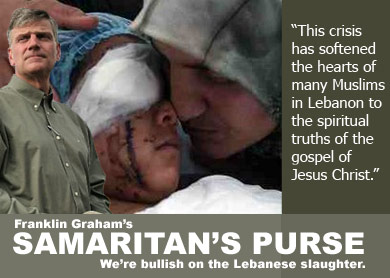 As you might expect, Samaritan's Purse, the Christian organization run by Franklin Graham (of "(Islam is a) very evil and a very wicked religion" infamy) has been exploiting the war in Lebanon to proselytize:
Samaritan's Purse has continued to reach out through its partners to the war-devastated people of southern Lebanon. "Right now," [Ken] Isaacs notes, "we're supporting a network of six pastors and over 20 volunteers who are working out through the schools."
One thing that has been interesting, the ministry spokesman says, is that "many Muslims have asked, 'Why are you Christians doing this?' -- and it has started a dialog." He says this crisis has softened the hearts of many Muslims in Lebanon to the spiritual truths of the gospel of Jesus Christ.
(h/t: J.G.)
July 23, 2006

July 20, 2006
July 19, 2006
July 15, 2006
American Islamic Centers by State
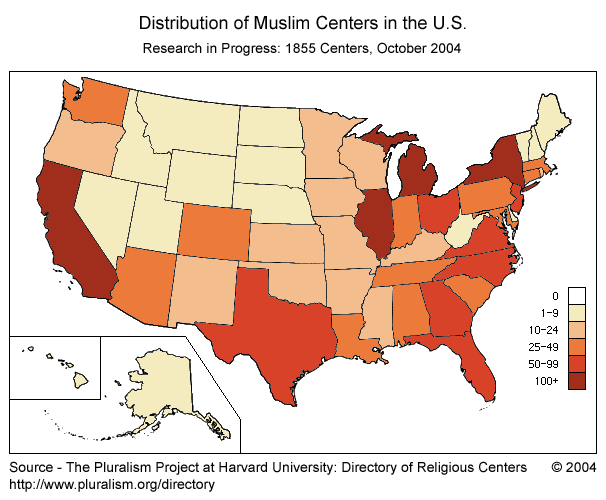
I just came across this map at the Pluralism Project. It's a geographical distribution of Islamic centers in the U.S. as of the Autumn of 2004. By the term "centers," I believe the researchers have included sites other than masjids (e.g., CAIR and MSA offices, and schools), plus the Ahmaddiya have been lumped in with the orthodox Muslims. If you click on the title link, you'll also find a number of similar maps for other non-Christian religions (e.g., Hinduism, Buddhism, etc.).
Fundies Say the Darndest Things!
Time to abuse your mind. All of the following quotations come from the website, Fundies Say the Darndest Things! These are most, but not all, of the quotations that dealt with either Islam or Muslims since June. A lot of these quotations are fairly typical of your typical ignorant American bigot (nothing new in that respect), although a few are "roll your eyes" weird. I've added a few of my own comments.
"They all should be taken out back and shot because in America we appreciate the fact that we live a life that the the whole world envy. Whoever doesn't stand for the pledge is not an American and is probably a homo, Muslim or related to Michael Moore. Fags"
-- Tanner [2006-Jun-03]
"You must regard the founders of the United States as being equivalent to Muslim fanatics as I paraphrased the Declaration of Independence."
-- kerwin [2006-Jun-05]
"When compared with Islam, it is obvious how different Christianity is. Islam is a religion with a capital R. It is about unquestioning obedience to what purports to be divine law. There is no theological development in Islam. Christianity is really about the unmasking of what we now know as religion. This produces a freedom from all religiosity, all idols, all gods. It is a mistake to think that fundamentalism represents Christianity. The temptation for us all is to become religious and that includes the secularist who claims the ascendancy of reason. Dig a bit below the surface and you will find the same old tired idols, the same fear of death, the same human triumphalism and belief in progress. That is why it is only radical Christianity that will truly set us free."
-- Sells [2006-Jun-18]
"White people are the reason why America is the great country it is today. It wasn't till our Nation was settled by the Europeans when we truly became powerful. We don't need Mexicans, Muslims, liberals, or 'diversity.' These impurities are slowly but surely overtaking what was once our great and purely American nation."
-- AryanPrideAmerica [2006-Jun-25] (JD: White boy here must have forgotten about how much of the U.S. was built upon the backs of the slaves, Chinese workers, and other non-whites.)
[In response to an article about a Muslim woman of color representing Australia in the Miss World Pageant]: "Another insult to christianity"
-- Vikingcelt [2006-Jun-25]
"Many have not made the connection, but I assure you that a very strong, obvious, and evil connection does exist between UFOs and the Gospel of Jesus Christ. There exists throughout the world various 'gifted' people who supposedly can contact aliens and channel their messages to us earthlings. This certainly is interesting to consider but here is the really intriguing point. These messages routinely attack, ridicule, or undermine Christianity. The aliens don’t seem to be threatened by Islam, Buddhism, Hinduism, or any other ism. They focus their attacks on Christianity. Could this be because Christianity is the only true religion? This would be my bet."
-- Ralph C. Barker [2006-Jul-06]
"Do you believe in chance and probability? What are the chances that christian and jewish settlements would manage to not be at major faultlines? Why would such ideologies not take root there? Why would places like communist Cuba be hit hardest by hurricanes? Why would muslim/buddist/hindu/Atheist countries like Indonesia, India, Cuba, etc...constantly be marred by natural catastrophe...only to have the reprocussions of the natural disasters disapate before they can effect neighboring areas?"
-- wanderphilos [2006-Jul-13] (JD: Clueless here must have forgotten Katrina, Rita, and the many other hurricanes, not to mention the flooding, earthquakes and other natural disasters that take place within the U.S. Duh!)
"They all should be taken out back and shot because in America we appreciate the fact that we live a life that the the whole world envy. Whoever doesn't stand for the pledge is not an American and is probably a homo, Muslim or related to Michael Moore. Fags"
-- Tanner [2006-Jun-03]
"You must regard the founders of the United States as being equivalent to Muslim fanatics as I paraphrased the Declaration of Independence."
-- kerwin [2006-Jun-05]
"When compared with Islam, it is obvious how different Christianity is. Islam is a religion with a capital R. It is about unquestioning obedience to what purports to be divine law. There is no theological development in Islam. Christianity is really about the unmasking of what we now know as religion. This produces a freedom from all religiosity, all idols, all gods. It is a mistake to think that fundamentalism represents Christianity. The temptation for us all is to become religious and that includes the secularist who claims the ascendancy of reason. Dig a bit below the surface and you will find the same old tired idols, the same fear of death, the same human triumphalism and belief in progress. That is why it is only radical Christianity that will truly set us free."
-- Sells [2006-Jun-18]
"White people are the reason why America is the great country it is today. It wasn't till our Nation was settled by the Europeans when we truly became powerful. We don't need Mexicans, Muslims, liberals, or 'diversity.' These impurities are slowly but surely overtaking what was once our great and purely American nation."
-- AryanPrideAmerica [2006-Jun-25] (JD: White boy here must have forgotten about how much of the U.S. was built upon the backs of the slaves, Chinese workers, and other non-whites.)
[In response to an article about a Muslim woman of color representing Australia in the Miss World Pageant]: "Another insult to christianity"
-- Vikingcelt [2006-Jun-25]
"Many have not made the connection, but I assure you that a very strong, obvious, and evil connection does exist between UFOs and the Gospel of Jesus Christ. There exists throughout the world various 'gifted' people who supposedly can contact aliens and channel their messages to us earthlings. This certainly is interesting to consider but here is the really intriguing point. These messages routinely attack, ridicule, or undermine Christianity. The aliens don’t seem to be threatened by Islam, Buddhism, Hinduism, or any other ism. They focus their attacks on Christianity. Could this be because Christianity is the only true religion? This would be my bet."
-- Ralph C. Barker [2006-Jul-06]
"Do you believe in chance and probability? What are the chances that christian and jewish settlements would manage to not be at major faultlines? Why would such ideologies not take root there? Why would places like communist Cuba be hit hardest by hurricanes? Why would muslim/buddist/hindu/Atheist countries like Indonesia, India, Cuba, etc...constantly be marred by natural catastrophe...only to have the reprocussions of the natural disasters disapate before they can effect neighboring areas?"
-- wanderphilos [2006-Jul-13] (JD: Clueless here must have forgotten Katrina, Rita, and the many other hurricanes, not to mention the flooding, earthquakes and other natural disasters that take place within the U.S. Duh!)
July 10, 2006
Koyaanisqatsi
This is one of those "Let's see if Youtube has any videos about..." posts. Today's subject, the 1983 movie, Koyaanisqatsi. This is one of my all-time favorite movies. Very much the deep-art house-make you think-type film. I first caught Koyaanisqatsi in its initial theatrical release; I happened to come across a flyer for the film at my community college, which, if I recall correctly, was playing that night at a nearby theatre. I had the time and was intrigued enough, so I went.
Wow!
The movie has become, for me, a standard, not just for watching other movies but also in the making of them (or, I should say, how I would like to make them). I have wanted to make a few short films in the Koyaanisqatsi "style." Insha'allah, some year. In the meantime, I continue to watch the DVD over and over (usually when Milady's not here as she doesn't like the movie as much as I do ;) ).
Following are three clips that Youtube has from the movie. The first covers the night-time traffic scene, the famous shot of the full moon rising, and the human foot-traffic at Grand Central Station (?); the second clip is very short, of the street lights taken from inside the speeding car (later in the same sequence from the first clip); and the third clip is from the very end of the movie, where the rocket explodes and the camera follows the burning fragment of the rocket nozzle down.
Run times: (1) 8:21, (2) 0:39, (3) 3:15.
Note: The music played at the very beginning and very end of the movie (with the men chanting "Koyaanisqatsi") is very reminiscent of the instrumental, "Genesis Ch. 1 V. 32," by the Alan Parsons Project on their album, "I Robot." It would not surprise me at all if Phillip Glass "stole" a bit of that song's melody. (One of the members of the APP e-mail list sent me a short mp3 that compares the two songs, one after the other, and it seems that Glass' melody is more than coincidental in its likeness to the APP song, which came out in June 1977, six years earlier than the movie.)
Wow!
The movie has become, for me, a standard, not just for watching other movies but also in the making of them (or, I should say, how I would like to make them). I have wanted to make a few short films in the Koyaanisqatsi "style." Insha'allah, some year. In the meantime, I continue to watch the DVD over and over (usually when Milady's not here as she doesn't like the movie as much as I do ;) ).
Following are three clips that Youtube has from the movie. The first covers the night-time traffic scene, the famous shot of the full moon rising, and the human foot-traffic at Grand Central Station (?); the second clip is very short, of the street lights taken from inside the speeding car (later in the same sequence from the first clip); and the third clip is from the very end of the movie, where the rocket explodes and the camera follows the burning fragment of the rocket nozzle down.
Run times: (1) 8:21, (2) 0:39, (3) 3:15.
Note: The music played at the very beginning and very end of the movie (with the men chanting "Koyaanisqatsi") is very reminiscent of the instrumental, "Genesis Ch. 1 V. 32," by the Alan Parsons Project on their album, "I Robot." It would not surprise me at all if Phillip Glass "stole" a bit of that song's melody. (One of the members of the APP e-mail list sent me a short mp3 that compares the two songs, one after the other, and it seems that Glass' melody is more than coincidental in its likeness to the APP song, which came out in June 1977, six years earlier than the movie.)
One reason why I don't live up north anymore...
These clowns have a future in...er...auto wrecking. Run time: 0:27.
July 5, 2006
New Wallpaper @ Firaushah.com
 Yes, I'm alive. :)
I've been wanting to write for the blog these past few days, but I've been fairly busy with various things. Milady and I had our regular Fardhu Ain class Friday night, went to "Superman Returns" Saturday night, attended our first "Arabic for Beginners" class (at a local masjid) Sunday night, and then spent much of Monday afternoon at the beach, having a picnic with Milady's family. (Monday was "Youth Day," a public school holiday, so Milady and her sister, both of whom are primary school teachers, had the day off from work. Likewise, I don't have any classes to teach on Monday, so I went out with them as well. I came back from the beach fairly well sun-burned.) And then, of course, yesterday and today I've had to teach, so I've got a fair amount of work that needs doing here, there and everywhere.
One thing that I have gotten done is July's wallpapers for Firaushah.com. These are free for anyone who's signed up for our mailing list *or* who has filled out our hijab/tudung survey. So, if you haven't signed up (or filled out the survey), take a few seconds to do so now so you can download both June and July's wallpapers FREE!
June 28, 2006
World Oil Reserves
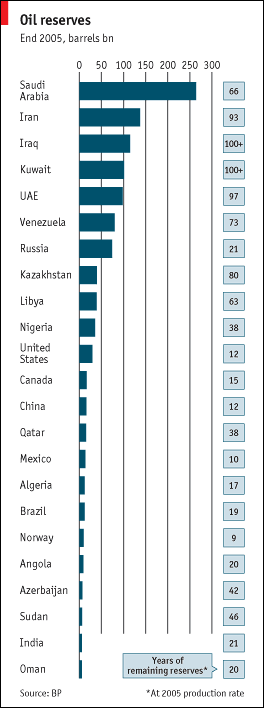 I've written about oil prices and world supplies on my blog in the past*, and I found the following information rather interesting. This also comes from the current issue of The Economist.
 The world had 1.2 trillion barrels of proven oil reserves at the end of 2005, according to BP. If overall production continues at last year's rate, known oil will last for 41 years. But it will run out more slowly in some countries than in others. At today's extraction rate, Saudi Arabia's reserves, which account for more than a fifth of the world total, will last for 66 years.
As you can see, at last year's production level, the remaining oil that is currently known to exist within U.S. borders will be completely pumped dry in 12 years - 2018. Mexico's reserves will be gone in 10 years (2016).
So, bought that electric car yet?
-------------
* See Oil: America's Smack and, more recently, How Much Oil Does America Import?
Eurabia: The Myth and Reality of Islam in Europe
 I happened to come across this week's issue of The Economist at a 7-Eleven today, and bought a copy. The cover story, as you can see is on "The Myth and Reality of Islam in Europe." Actually, The Economist printed three stories in this week's issue that deals with Islam, two of which are available online: Look Out, Europe, They Say, the cover story, and Tales from Eurabia, the editorial. (The third article, a review of four books that cover Islamic-Western relations, is only available for Economist subscribers; to be honest, you're not missing much.)
 I'm wanting to comment more on the main article in the Firaushah newsletter that I hope to publish in a few days, insha'allah; however, I will say that I thought the main article was fairly balanced. The editorial, IMO, is less so. While the editors have come to the correct conclusion that "...the prospect of Eurabia looks like scaremongering", they also show a bias against and ignorance about Islam by writing, "In 50 years' time, Americans may be praising this generation of European Muslims for leading the enlightenment that Islam needed."
In the meantime, I will say that I do like that cover. :) "Inspiring," he says (as every French non-Muslim recoils in horror ;) ). Insha'allah, wa Allahu Akbar! :)
You've Got Frustration!
This is not one of my typical videos, being a news account, but it is funny in a perverse sort of way. Vincent Ferrari, interviewed here by WNBC, had heard the horror stories of people trying to cancel their AOL accounts. So he tried to cancel his own account, and recorded the telephone conversation. What follows is a prime example of how not to treat your customer. Golden moment: Ferrari, who is 30, is asked by the customer "service" rep to put Ferrari's dad on the phone so that the rep can plead with the dad for Ferrari to keep his account. Run time: 5:00.
June 27, 2006
Rhea, Mimas and Enceladus

This is an interesting animation, taken by the spacecraft Cassini, which is orbiting Saturn. The movie was taken on January 27, 2006, using 59 clear-filter images taken over a period of about 40 minutes. The camera was centered on Rhea, with Mimas passing by on the top and Enceladus on the bottom.
What this animation doesn't show you is the apparent distance between these three moons of Saturn. In the animation, it looks like Rhea, the large moon in the center, orbits between Mimas and Enceladus. In fact, if you look at this diagram, you'll see that Mimas and Enceladus are much closer in to Saturn than Rhea is; i.e., Rhea has an orbit that's much further out from Saturn. However, Rhea is much larger (with a diameter of 1,528.8 km) than either Mimas (396.6 km) or Enceladus (504.2 km).
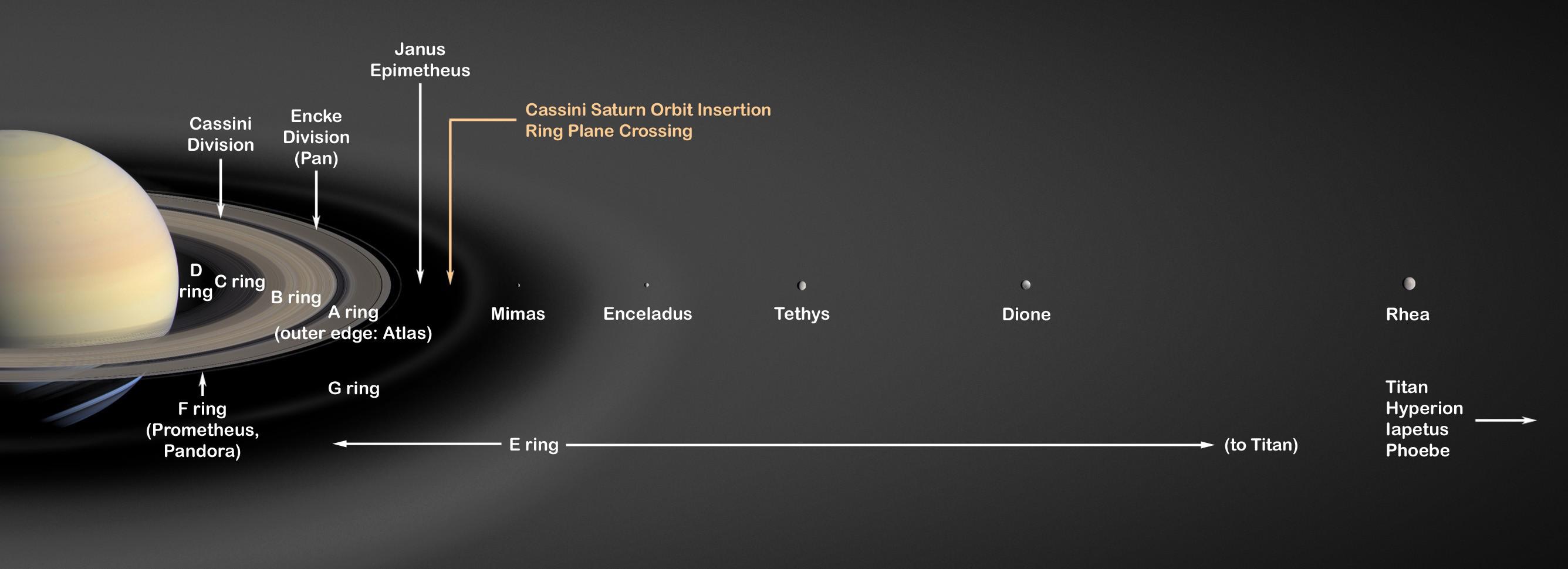
June 26, 2006
The Firaushah Hijab/Tudung Survey
 Firaushah would like to know more about what women look for in hijabs and tudungs. Of course we have our own ideas about what makes for a beautiful hijab or tudung, but we'd like to find out what you think too. Please take a few moments to answer our very short questionnaire. In appreciation for your taking the time to fill out our survey, we'd like to offer you a FREE wallpaper for your computer desktop!
June 25, 2006
The Coulter-Hitler Quiz
Hate Ann Coulter? Join the queue (it ends waaaay back there). In the meantime, test yourself with this quiz of quotations by both Ann and Adolf Hitler (and, no, not the quiz is not rigged with all of the answers being Ann :) ).
June 20, 2006
It's a Matter of Latitude

So I'm visiting Astronomy Picture of the Day as I do most days, and I find out that there are webcams located at the North Pole. How cool is that? ;) (And, yes, the pun was intentional.) Of course, there are numerous scientific bases located on Antarctica, including the South Pole, but that's solid land that can be built upon. The North Pole is covered with ice only 2-3 meters thick, so permanent structures are impossible. But, the US government (in the form of NOAA) has been sending up several webcams every year since April 2002. The above photo was taken from the Moods of the North Pole in 2006 webpage, which gives a nice selection of photos, from the blue and pink (such as in the above photo), to the yellow and desert-looking, to the dull grey and overcast.
Here in Singapore (11 pm), one degree north of the equator, the sky is calm and cloudy (as usual) with a temperature of 26 degrees Celcius (79 degrees Farenheit).
June 18, 2006
American Fascism
The following article was written by the Rev. Charles Hoffacker, an Episcopal priest, and originally appeared in the Port Huron (MI) Times-Herald. I have some brief comments at the end.
A recent study identifies characteristics common to seven fascist regimes. Laurence W. Britt examines regimes in Germany, Italy, Spain, Portugal, Greece, Chile, and Indonesia-all of them eventually overthrown - and notes these 14 patterns of national behavior that each regime engaged in to one extent or another.
Does this sound familiar? Ample parallels can be found between Britt's portrait of fascism and events in early 21st-century America.
Fascism is an ideology built on fear. What breaks the allure of fascism is a faith too authentic to accept lies. One form of this faith is belief in a God of compassion whose perfect love casts out fear. Another is belief in the ability of a free people to govern themselves.
We do not strive for a justice based on repentance and encounter with the God of compassion. Distracted in countless ways, disconnected from one another, we remain deeply ignorant of how all people are one people.
This nation once engaged in a gigantic military struggle to defeat European fascism. We must now undertake a spiritual struggle to defeat the fascism now threatening our hearts and our public life.
Rev. Hoffacker's comment regarding "...belief in a God of compassion whose perfect love casts out fear" reminded me of an ayah in the Qur'an:
"It is but Satan who instils [into you] fear of his allies: so fear them not, but fear Me, if you are [truly] believers!" (3:175)
Is it any wonder that the fascist neo-cons, who have built their entire philosophy upon a series of lies as flimsy as a house of cards, would choose the Muslim ummah and Islam as their enemy du jour? That they have focused their attack on a religion whose members aren't interested in submitting to mere men, but who submit only to Allah (swt)?
Governments, in both their form and as individual entities, come and go; Allah (swt) and Islam remain.
"Have they, then, never journeyed about the earth and beheld what happened in the end to those [willful sinners] who lived before their time? God destroyed them utterly: and the like thereof awaits all who deny the truth." (47:10)
Hulagu Khan (1217-65), grandson of Chinggis Khan, siezed Baghdad in 1258, killing the last Abbasid caliph and making a pyramid of the skulls of Baghdad's scholars, religious leaders, and poets. What must the people of that time felt, seeing the wholesale slaughter and destruction? And yet the Mongol civilization that sacked Baghdad was long ago reduced to dust upon the wind, just as were many other civilizations that had threatened Islam in the past.
Better for all of us to fear Allah (swt). The neo-cons are merely the latest incarnation of a failed system of government.
A recent study identifies characteristics common to seven fascist regimes. Laurence W. Britt examines regimes in Germany, Italy, Spain, Portugal, Greece, Chile, and Indonesia-all of them eventually overthrown - and notes these 14 patterns of national behavior that each regime engaged in to one extent or another.
- Powerful and continuing expressions of nationalism. This was usually coupled with a suspicion of things foreign.
- Disdain for human rights. Victims of human rights abuse were marginalized or abuse was concealed.
- Identification of scapegoats as a unifying cause. Scapegoating directed attention away from public problems and channeled frustration into controlled directions.
- Avid militarism. The military was used to assert national goals, intimidate other countries, and increase the ruling elite's prestige.
- Rampant sexism. Women were treated as second-class citizens. Homophobia was intensified.
- A controlled mass media. Leaders of the mass media were often compatible with the regime and kept the public unaware of the regime's excesses.
- Obsession with national security. A national security apparatus served as an instrument of internal repression.
- Religion and ruling elite tied together. Propaganda kept up the illusion that those in power were opponents of the "godless."
- Power of corporations protected. The ability of large corporations to act in relative freedom was not compromised even when personal liberties were curtailed.
- Power of labor suppressed or eliminated. The poor were seen as an underclass and viewed with suspicion or contempt.
- Disdain and suppression of intellectuals and the arts. Artistic and academic freedom were considered subversive.
- Obsession with crime and punishment. Severe systems of criminal justice produced huge prison populations. Police power was almost unchecked, leading to widespread abuse.
- Rampant cronyism and corruption. The economic elite and the power elite enriched one another through unethical favoritism.
- Fraudulent elections. When elections with candidates took place, they would usually be perverted by those in power to achieve the desired result.
Does this sound familiar? Ample parallels can be found between Britt's portrait of fascism and events in early 21st-century America.
Fascism is an ideology built on fear. What breaks the allure of fascism is a faith too authentic to accept lies. One form of this faith is belief in a God of compassion whose perfect love casts out fear. Another is belief in the ability of a free people to govern themselves.
We do not strive for a justice based on repentance and encounter with the God of compassion. Distracted in countless ways, disconnected from one another, we remain deeply ignorant of how all people are one people.
This nation once engaged in a gigantic military struggle to defeat European fascism. We must now undertake a spiritual struggle to defeat the fascism now threatening our hearts and our public life.
Rev. Hoffacker's comment regarding "...belief in a God of compassion whose perfect love casts out fear" reminded me of an ayah in the Qur'an:
"It is but Satan who instils [into you] fear of his allies: so fear them not, but fear Me, if you are [truly] believers!" (3:175)
Is it any wonder that the fascist neo-cons, who have built their entire philosophy upon a series of lies as flimsy as a house of cards, would choose the Muslim ummah and Islam as their enemy du jour? That they have focused their attack on a religion whose members aren't interested in submitting to mere men, but who submit only to Allah (swt)?
Governments, in both their form and as individual entities, come and go; Allah (swt) and Islam remain.
"Have they, then, never journeyed about the earth and beheld what happened in the end to those [willful sinners] who lived before their time? God destroyed them utterly: and the like thereof awaits all who deny the truth." (47:10)
Hulagu Khan (1217-65), grandson of Chinggis Khan, siezed Baghdad in 1258, killing the last Abbasid caliph and making a pyramid of the skulls of Baghdad's scholars, religious leaders, and poets. What must the people of that time felt, seeing the wholesale slaughter and destruction? And yet the Mongol civilization that sacked Baghdad was long ago reduced to dust upon the wind, just as were many other civilizations that had threatened Islam in the past.
Better for all of us to fear Allah (swt). The neo-cons are merely the latest incarnation of a failed system of government.
June 15, 2006
Local Blogger Blasphemes the Prophet Jesus (saws)
As my readers may or may not know, it is illegal here in Singapore, under the Sedition Act, to post inflammatory comments (including cartoons) on the Internet "...which may cause feelings of ill-will and hostility between different races or classes of the population of Singapore." I blogged about this several months ago (Islamophobia = Sedition), partly in response to the Danish cartoons scandal. Singapore, as I noted in another blog post (Heroes and Hypocrites) would never have allowed the offending cartoons to be published in the first place (nor were they ever published here).
Prior to the Danish cartoon scandal, three young Chinese men were charged last year with making seditious and inflammatory racist comments on the Internet against the Malay/Muslim community. All three pled guilty. Now we have a new case. In a Straits Times article that made the front page of the paper Wednesday (14 June), another young man is being investigated for publishing inflammatory cartoons of the Prophet Jesus (saws). An excerpt from the article:
A 21-year-old accounts assistant is being investigated for allegedly flouting the Sedition Act by publishing pictures on his blog that were thought to depict Jesus Christ in an offensive manner. The blogger, who used the online moniker Char, had found the cartoons on the Internet and began posting them in January. He told The Straits Times last week that he was called in by the police for questioning in March, after they received a complaint. Yesterday, the police confirmed they are investigating the matter but declined to give details as "investigations are still ongoing."
News of the investigation was announced online by Char himself last week when he sent an e-mail to a mailing list of more than 300 young Singaporeans. He told them of his experience and how it came about. He removed the cartoons from his blog after he was questioned.
Describing himself as a free thinker, he said he had posted a cartoon that depicted Jesus as a zombie biting a boy's head in January. The following month, he received an online message asking him to remove the image. It came amid the global furore over the publication of caricatures of the Prophet Muhammad by several newspapers. Char did not reply to the message but chose to irk the person instead. He searched the Internet for more pictures depicting Jesus and published three of them on his blog. Looking back, he felt he made an "unwise" move. "I never thought anyone would complain to the police because the pictures were not insidious," he said.
The good news (from my perspective) is that I don't think "Char" is either Muslim or Malay (Update: he's neither). I don't think this was a case of a Muslim trying to get back at Christians for the Danish cartoons fiasco. But I do support Singapore's use of the Sedition Act against Char; Muslims and Christians shouldn't have to put up with derogatory comments and cartoons that blaspheme their faiths. My only question now is, assuming Char either pleads or is found guilty, how he would be sentenced. The maximum penalty for this crime is jail for up to three years or a maximum fine of $5,000, or both. None of the three men who pled guilty last year had sentences that were remotely close to the maximum penalty; however, the judge at that time also said that future sentences would be stiffer should similar offences occur. We shall see, insha'allah.
Update: Since I wrote this post, I've gained a little bit of local notariety. Friday evening, I was interviewed on the phone by a reporter from The Straits Times (the largest newspaper in S'pore). The reporter was working on a follow-up article to the Wednesday article, and a brief excerpt from my post was published in the Sunday (18 June) paper:
There were several netizens who also backed tough action. One was a Muslim American management lecturer based here, known online as "JD".
Said the 44-year-old: "I support Singapore's use of the Sedition Act. People shouldn't have to put up with derogatory comments and cartoons that blaspheme their faiths."
-- "Divided Views Over Police Checks on Blogger," p. 11
(I'm also happy to say that, in this latest article, my position as expressed above was similar to the thoughts of Father John-Paul Tan, parish priest of the Church of St. Mary of the Angels, Anglican Bishop and vice-president of the National Council of Churches of Singapore John Tew, and chairman of the Centre for Contemporary Islamic Studies Ridzuan Wu, all of whom were also interviewed for the follow-up article.)
Then, this morning I was contacted by another person for the Straits Times, who asked if I minded being listed for the "Blogs of the Week" column (specifically about this post) in next Wednesday's "Digital Times," a weekly supplement to the Straits Times that focuses on IT, blogging, computer games, etc. Of course I said "yes," so we'll see how things go from here.
Prior to the Danish cartoon scandal, three young Chinese men were charged last year with making seditious and inflammatory racist comments on the Internet against the Malay/Muslim community. All three pled guilty. Now we have a new case. In a Straits Times article that made the front page of the paper Wednesday (14 June), another young man is being investigated for publishing inflammatory cartoons of the Prophet Jesus (saws). An excerpt from the article:
A 21-year-old accounts assistant is being investigated for allegedly flouting the Sedition Act by publishing pictures on his blog that were thought to depict Jesus Christ in an offensive manner. The blogger, who used the online moniker Char, had found the cartoons on the Internet and began posting them in January. He told The Straits Times last week that he was called in by the police for questioning in March, after they received a complaint. Yesterday, the police confirmed they are investigating the matter but declined to give details as "investigations are still ongoing."
News of the investigation was announced online by Char himself last week when he sent an e-mail to a mailing list of more than 300 young Singaporeans. He told them of his experience and how it came about. He removed the cartoons from his blog after he was questioned.
Describing himself as a free thinker, he said he had posted a cartoon that depicted Jesus as a zombie biting a boy's head in January. The following month, he received an online message asking him to remove the image. It came amid the global furore over the publication of caricatures of the Prophet Muhammad by several newspapers. Char did not reply to the message but chose to irk the person instead. He searched the Internet for more pictures depicting Jesus and published three of them on his blog. Looking back, he felt he made an "unwise" move. "I never thought anyone would complain to the police because the pictures were not insidious," he said.
The good news (from my perspective) is that I don't think "Char" is either Muslim or Malay (Update: he's neither). I don't think this was a case of a Muslim trying to get back at Christians for the Danish cartoons fiasco. But I do support Singapore's use of the Sedition Act against Char; Muslims and Christians shouldn't have to put up with derogatory comments and cartoons that blaspheme their faiths. My only question now is, assuming Char either pleads or is found guilty, how he would be sentenced. The maximum penalty for this crime is jail for up to three years or a maximum fine of $5,000, or both. None of the three men who pled guilty last year had sentences that were remotely close to the maximum penalty; however, the judge at that time also said that future sentences would be stiffer should similar offences occur. We shall see, insha'allah.
Update: Since I wrote this post, I've gained a little bit of local notariety. Friday evening, I was interviewed on the phone by a reporter from The Straits Times (the largest newspaper in S'pore). The reporter was working on a follow-up article to the Wednesday article, and a brief excerpt from my post was published in the Sunday (18 June) paper:
There were several netizens who also backed tough action. One was a Muslim American management lecturer based here, known online as "JD".
Said the 44-year-old: "I support Singapore's use of the Sedition Act. People shouldn't have to put up with derogatory comments and cartoons that blaspheme their faiths."
-- "Divided Views Over Police Checks on Blogger," p. 11
(I'm also happy to say that, in this latest article, my position as expressed above was similar to the thoughts of Father John-Paul Tan, parish priest of the Church of St. Mary of the Angels, Anglican Bishop and vice-president of the National Council of Churches of Singapore John Tew, and chairman of the Centre for Contemporary Islamic Studies Ridzuan Wu, all of whom were also interviewed for the follow-up article.)
Then, this morning I was contacted by another person for the Straits Times, who asked if I minded being listed for the "Blogs of the Week" column (specifically about this post) in next Wednesday's "Digital Times," a weekly supplement to the Straits Times that focuses on IT, blogging, computer games, etc. Of course I said "yes," so we'll see how things go from here.
Subscribe to:
Posts (Atom)