More than 200 people at a Peoria conference got a jolt of reality along with their caffeine from Arizona State University President Michael Crow, who said a collective "arrogant ignorance" holds the nation back.
He cited an education system that's not innovative enough, a lack of awareness or acknowledgment of global competition and lack of long-term vision.
Crow, the morning keynote speaker Thursday at the city's second annual Positive Action through Civic Engagement conference didn't mince words in his hourlong address, taking on what he called the "800-pound elephant sitting in the room."
The state of the economy.
Crow said the country needs to work toward a common goal of economic success and global competitiveness, which would help achieve other goals of social, cultural and community development.
He outlined "realistic assessments" of the United States, often forcefully, thumping the lectern on stage at the Arizona Broadway Theatre.
The ASU president said the country is resting on its laurels, which is not enough to come out of the economic morass.
"We don't understand the rise and the development of the rest of the world as competitors; we feel it but we don't understand it," he said. "We are going to have to look ourselves in the mirror, pull ourselves together as a community and literally re-think many, many things."
Crow said looking to the federal government for all the answers is not the solution. He urged the audience, comprising business, education and community leaders, to understand that the solutions to problems come from communities.
"Communities and states are the laboratories of democracy," he said. "We are the means by which solutions will be derived, new pathways will be engineered."
Crow also criticized the K-12 and higher-education systems for being "insufficiently innovative," and stifled by the "model of the past."
He said the focus should be on how K-12 schools are doing, "not compared with the school down the street or the school up in Flagstaff," but with schools internationally.
"We're not where we should be," Crow said.
He took on his peers, other research university presidents, for thinking narrowly only of the elite students and educators. They must be more inclusive to better educate the country.
"The level of arrogance among these individuals and these institutions is beyond belief," Crow said.
He spoke of the need to think big, not in the narrow prism of growth within a city or company but regionally, to compete not with Tempe or Tucson but with Singapore or Shanghai.
For that, he singled out the need to think about growth in the context of the larger Sun Corridor in Arizona, one of 10 megapolitans identified as hubs for growth because of their collective infrastructure and resources. The corridor stretching from Prescott to Tucson, across Yavapai, Maricopa, Pinal and Pima counties, has a collective economy the size of Finland, Malaysia or the United Arab Emirates, he said.
To compete globally, leaders would have to take the long-term view and make decisions regionally.
Crow said it doesn't help to just focus on dealing with people who no longer have jobs and how to keep them going in the short-term with unemployment benefits. Leaders must focus on how the unemployed are being prepared for the jobs that need filled going forward.
"By being economically competitive, we can build from that the societies we want," Crow said.
The speech impressed several audience members.
AARP Arizona volunteer Virginia Correa Creager told Crow she would work to spread the word. "It's incumbent on us not to just listen to you today, not to just take notes from you today but it's incumbent upon us to reach out into the community and spread the message that you gave us today," she said.
The message of working collectively for the larger cause of economic prosperity hit home for Sandy Mendez Benson of Washington Elementary School District. She said that's something she works on at the local level, "trying to pool resources and ideas" between schools and the local businesses and community residents.
Showing posts with label Arizona State University. Show all posts
Showing posts with label Arizona State University. Show all posts
December 1, 2011
America's "Arrogant Ignorance"
The following appeared in the November 19th edition of the Arizona Republic. I completely agree with Dr. Michael Crow's assessment of the situation in the United States. Dr. Crow mentioned the idea of Americans resting on their laurels; in my opinion, not only is this true, but the problem is exacerbated by many Americans' believing in "American exceptionalism." I can tell you that not only do other people around the world not believe in the idea of how "exceptional" the United States is, but that they are working as hard as possible to be better than Americans in all sorts of fields: education, commerce, industry, and so forth. Too many Americans would rather be fat, stupid and lazy, then complain about why the rest of the world is passing them by and taking "their" jobs. Dr. Crow's message should be a wake-up call to Americans that they need to rethink how American society should operate before the so-called "American exceptionalism" turns permanently into "American mediocrity." The United States is already on its way there.


January 24, 2010
Tycho Crater by LRO

Tycho Crater is an one of the most prominent craters on the moon. It appears as a bright spot in the southern highlands with rays of bright material that stretch across much of the nearside. Its prominence is not due to its size: at 85 km in diameter, it's just one among thousands of this size or larger. What really makes Tycho stand out is its relative youth. It formed recently enough that its beautiful rays, material ejected during the impact event, are still visible as bright streaks. All craters start out looking like this after they form, but their rays gradually fade away as they sit on the surface, exposed to the space environment which over time darkens them until they fade into the background.
How old is Tycho? Because the impact event scattered material to such great distances, it's thought that some of the samples at the Apollo 17 landing site originated at the Tycho impact site. These samples are impact melt glass, and radiometric age dating tells us that they formed 108 million years ago. So if these samples are truly from Tycho, the crater formed 108 million years ago as well. This may still seem old, but compared to the 3.9 billion-year age for many large lunar craters, Tycho is the new kid on the block. Directly sampling material from within the crater would help us learn more about not just when Tycho formed, but the ages of terrains on other planets throughout the solar system.
...
Tycho is also of great scientific interest because it is so well preserved, it is a great place to study the mechanics of how an impact crater forms. ... The peak is thought to be material that has rebounded back up after being compressed in the impact, and though it's a peak now, it originated at greater depth than any other portion of the crater. The floor of the crater is covered in impact melt, rocks that were heated to such high temperatures during the impact event that they turned to liquid, and flowed across the floor. In [this] image, impact melt flowed downhill and pooled, where it cooled.
Photo Credit: NASA/Goddard/Arizona State University
May 14, 2009
Links for 14 May 2009
Politics:
What Obama Means when he says "the troops" ("People keep telling me that America is a better place since 20 January 2009. As with the claims of economic recovery 'right around the corner,' there is precious little evidence.")
Countdown's Worst Person: Your Not So Grass Roots Are Showing
RNC having special session to brand the Democratic Party 'Socialists' (I'll accept the "socialist" moniker as long as we can call the Republicans "Nazis.")
C&L's Late Night Music Club with Yusuf Islam (The website Crooks & Liars does a nightly music video, with tonight's video being Yusuf Islam's Peace Train.)
Daily Show's Jason Jones explores ASU's pristine academic environment (As an alumnus of Arizona State twice over (Bachelors and Masters), I find Jones' humor lame. As anyone remotely affiliated with the university would know, that's not the library. And the students he interviewed strike me as fraternity/sorority types; you know, not exactly the brightest bulbs on campus. BTW, Jason, what university did you graduate from? Ryerson University? Where's that?)
Did You Have Your Bowl of Cholesterol Drugs This Morning? (An interesting story developing between the FDA and General Mills: the way in which Cheerios, the breakfast cereal, is being marketed has caused the FDA to declare the cereal a drug. "General Mills may not legally market Cheerios unless it applies for approval as a new drug or changes the way it labels the small, doughnut-shaped cereal, the FDA said.")
GOP icon declares his party "brain dead" (The rest of us already knew this...)
Economics:
The Renminbi as the Reserve Currency? (There's an interesting thought! Not that it would happen anytime soon...)
China Expands Global Role
Islam/Muslim Blogs:
Of Life and Star Trek and Sex Education (Rozas' take on a conversation between some teenage Malay girls is rather interesting.)
The BNP is a threat to every Muslim
Just one in eight terror arrests ends with guilty verdict, admits Home Office
Miscellaneous:
A Space Shuttle Before Dawn (The space shuttle Atlantis, sitting on Launch Pad 39A, back in April, as it was being prepared for its launch a few days ago. Cool pic.)
INTERVIEW: C.J. Cherryh (CJ Cherryh is one of my favorite SF authors; she recently gave a brief interview in connection with her new novel, Regenesis, which is a sequel to her 1988 novel, Cyteen. Good news!)
382 – Two Eggs and a Kidney: Regional World Cities (Strange Maps is a blog I've been reading for quite a while now; check it out if you're unfamiliar with it. With respect to this map, I'm a little surprised LA isn't considered at least a major regional center, as Singapore and Hong Kong are. These latter two cities (S'pore and HK) do seem to be mirror images of each other in terms of being major regional centers, but I would expect people from Sydney might argue about whether they or S'pore has more influence in the southern half of the Asia and Oceania map.)
What Obama Means when he says "the troops" ("People keep telling me that America is a better place since 20 January 2009. As with the claims of economic recovery 'right around the corner,' there is precious little evidence.")
Countdown's Worst Person: Your Not So Grass Roots Are Showing
RNC having special session to brand the Democratic Party 'Socialists' (I'll accept the "socialist" moniker as long as we can call the Republicans "Nazis.")
C&L's Late Night Music Club with Yusuf Islam (The website Crooks & Liars does a nightly music video, with tonight's video being Yusuf Islam's Peace Train.)
Daily Show's Jason Jones explores ASU's pristine academic environment (As an alumnus of Arizona State twice over (Bachelors and Masters), I find Jones' humor lame. As anyone remotely affiliated with the university would know, that's not the library. And the students he interviewed strike me as fraternity/sorority types; you know, not exactly the brightest bulbs on campus. BTW, Jason, what university did you graduate from? Ryerson University? Where's that?)
Did You Have Your Bowl of Cholesterol Drugs This Morning? (An interesting story developing between the FDA and General Mills: the way in which Cheerios, the breakfast cereal, is being marketed has caused the FDA to declare the cereal a drug. "General Mills may not legally market Cheerios unless it applies for approval as a new drug or changes the way it labels the small, doughnut-shaped cereal, the FDA said.")
GOP icon declares his party "brain dead" (The rest of us already knew this...)
Economics:
The Renminbi as the Reserve Currency? (There's an interesting thought! Not that it would happen anytime soon...)
China Expands Global Role
Islam/Muslim Blogs:
Of Life and Star Trek and Sex Education (Rozas' take on a conversation between some teenage Malay girls is rather interesting.)
The BNP is a threat to every Muslim
Just one in eight terror arrests ends with guilty verdict, admits Home Office
Miscellaneous:
A Space Shuttle Before Dawn (The space shuttle Atlantis, sitting on Launch Pad 39A, back in April, as it was being prepared for its launch a few days ago. Cool pic.)
INTERVIEW: C.J. Cherryh (CJ Cherryh is one of my favorite SF authors; she recently gave a brief interview in connection with her new novel, Regenesis, which is a sequel to her 1988 novel, Cyteen. Good news!)
382 – Two Eggs and a Kidney: Regional World Cities (Strange Maps is a blog I've been reading for quite a while now; check it out if you're unfamiliar with it. With respect to this map, I'm a little surprised LA isn't considered at least a major regional center, as Singapore and Hong Kong are. These latter two cities (S'pore and HK) do seem to be mirror images of each other in terms of being major regional centers, but I would expect people from Sydney might argue about whether they or S'pore has more influence in the southern half of the Asia and Oceania map.)
June 1, 2008
Bounce!
I was amused at this photo taken by the Arizona Republic. The photo shows Arizona State University softball players Renee Welty, left, and Kaitlin Cochran, celebrating their win over Northwestern University on May 24th. (The entire slideshow of pictures can be found here.) Yes, I do feel a twinge of professional jealousy, wanting to have taken such a lucky shot! :)


April 21, 2008
Good Fathers Read to Their Sons
One of my sisters mailed me a copy of Jim Trelease's book, The Read-Aloud Handbook, originally published in 1979 and now in its sixth edition. Trelease's thesis is that by having parents -- including fathers -- read stories or books aloud to their children, that the child's reading comprehension and academic achievement will increase dramatically. The book is well researched (the following passage alone contained five footnotes, which I've omitted), but many of the facts presented are eye-opening -- and disturbing -- to say the least. The problem is that many American families have placed the burden of the parent reading aloud to their children on the mother. Not that this is completely surprising; after all, mothers are the primary care givers to children under five, regardless of whether she works or not, and he almost always is the primary bread-winner. But that doesn't mean that he can abdicate all responsibility toward his child's intellectual development. There are ways a father can encourage his child or children to read. One of my brothers-in-law, the husband of my sister who mailed me this book, takes his four children to the library once a week, every week. My own father was another bookworm who often read for pleasure, whether it was fiction or non-fiction. As a child, I remember my mom telling us kids (on numerous occasions) that dad wasn't going to wake up soon because he had been reading until two a.m. And, of course, my sisters and I were always encouraged to read. (As a teenager, I often read from our World Book encyclopedia or its various yearbooks for pleasure. Yeah, I know, I was a strange kid, but I've never lost while playing Trivial Pursuit either, so there! ;) )
The following passage comes from a section entitled, How do I convince my husband he should be doing this with our children? (pp. xxii-xxiv of the Introduction). What's surprising and scary is how much American boys have slipped behind girls academically since 1970. For years, we've read articles about how the number of female students has grown in American universities, but usually within the context of a single department or degree program (e.g., law school, medical school, etc.). But apparently the problem is much more widespread. Even looking at my own university's data (Fall 2006 statistics), female students outnumber male students for both undergraduates (53%-47%) and graduates (54%-46%). (For the Honors College, the gender ratio is the same as the graduate students' ratio, 54%-46% in favor of females.) So if you parents want your sons (and daughters) to do well at school, start reading to them now... even if they're teenagers.
The following passage comes from a section entitled, How do I convince my husband he should be doing this with our children? (pp. xxii-xxiv of the Introduction). What's surprising and scary is how much American boys have slipped behind girls academically since 1970. For years, we've read articles about how the number of female students has grown in American universities, but usually within the context of a single department or degree program (e.g., law school, medical school, etc.). But apparently the problem is much more widespread. Even looking at my own university's data (Fall 2006 statistics), female students outnumber male students for both undergraduates (53%-47%) and graduates (54%-46%). (For the Honors College, the gender ratio is the same as the graduate students' ratio, 54%-46% in favor of females.) So if you parents want your sons (and daughters) to do well at school, start reading to them now... even if they're teenagers.
The second change is a huge gender gap among American schoolchildren. Since 1970, there's been a steady gain in female achievement, accompanied by a steep drop in male performance. ... In 1970, male enrollment in college was 59 percent, female 41 percent. Three decades later, it's almost completely reversed -- 57 percent female, 43 percent male.
The top 10 percent of high school classes is 56 percent female, 44 percent male; among high school graduates who maintain an A average, 62 percent are female, 38 percent male. Three out of five high school National Honor Society members are girls, and they outnumber boys 124 to 100 in Advanced Placement (AP) classes. As recently as 1987, boys had outnumbered girls in those classes. ...
We know what caused the rise in the girls' scores -- their mothers' value systems about education changed thirty years ago. Mothers now expect more of their daughters intellectually. But how do we explain the nosedive on the part of the boys since 1970? Is it a coincidence that in that same year, 1970, we saw the birth of a national TV phenomenon called Monday Night Football? Prior to that, Madison Avenue pretty much thought it was a waste of time trying to advertise to men late at night -- they were all asleep in their La-Z-Boys. Then along comes MNF and they've got millions of guys doing high fives on their chairs at 11 p.m. It didn't take long for the networks to catch on that sports at night could bring in a boatload of advertising dollars and thus was born ESPN, then ESPN2, followed by channels for golf, rodeo, NASCAR, wrestling, extreme sports -- you name it, all sports, all the time, 24/7.
The impact on the young male of seeing his dad worshiping daily and nightly at the altar of ESPN, has to have played a damaging role in male attitudes about school. Girls read and write; guys hit, throw, catch, shoot, and fish. By 2000, moms were "taking their daughters to work," but dads were still taking their sons to the stadium.
The father who can find his way only to ball games with his kids is a "boy-man," whereas the father who can find his way to a ball game and to the library can be called a "grown man." Unfortunately, we have a growing shortage of grown men in America today. Once I asked members of an audience in Decatur, Georgia, if they thought they'd ever hear a president of the United States make a statement like that to the American people, and a woman replied, "Yes -- as soon as she's elected!"
The strange thing is that this "dumbing of Daddy" seems to affect families at all education levels. In a study comparing poverty-level families and university-educated families, fathers in both groups read to the children only 15 percent of the time, mothers 76 percent, and others 9 percent. That could change if we publicized studies like one conducted in Modesto, California, which showed that (1) boys who were read to by their fathers scored significantly higher in reading achievement, and (2) when fathers read recreationally, their sons read more and scored higher than did boys whose fathers did little or no recreational reading. When the dads were surveyed, only 10 percent reported having fathers who read to them when they were children.
February 7, 2008
What a freakin' crybaby!
Can't beat your in-state rival? Lose recruits to your in-state rival? Do you suck it up and try harder? No. You call your in-state rival names. Yeah, that'll solve your problems, coach! Pussy! :) From the Arizona Republic:
The smoldering Arizona-Arizona State football rivalry grew hotter on Wednesday when Wildcats coach Mike Stoops said ASU has "turned into a J.C."
Speaking at a football signing day news conference in Tucson, Stoops said some recruits had told him that it was easier to earn acceptance at ASU.
"Each school has to recruit to that school and what type of academic requirements there are," Stoops said. "Obviously, Arizona State has turned into a J.C. and we are a four-year college. According to all the players, they say it is easier to go to school there, easier to get in. I thought we had the same requirements. It is news to me."
It was also news to ASU coach Dennis Erickson, who had little to say about Stoops' remarks.
"He can say what he wants," Erickson said. "We're all the same. There is no difference.
"The bottom line with recruiting, and all that talking back and forth and all the stuff, is who's going to win games and who isn't right now," said Erickson, who defeated Stoops and Arizona 20-17 on Dec. 1 in Tempe. "What we've done with our group academically, as far as helping our guys be successful, that's what it's all about.
...
Tensions between the football programs, located 90 miles apart, grew last month when highly touted tailback Ryan Bass of Corona, Calif., backed out of an oral commitment to Arizona and said he would attend ASU. Bass was among the 27 signees announced by the Sun Devils on Wednesday.
Arizona signed only two players from the state - seven fewer than Arizona State. The disparity could be a byproduct of ASU's three-game win streak in the Territorial Cup series. Stoops is 1-3 against Arizona State.
December 2, 2007
ASU Triumphant (Yet Again)

My university, Arizona State, has won the Territorial Cup for the third straight year over my other university, the University of Arizona. (I attended the U of A for two years, but got my two degrees from ASU; I consider myself a Sun Devil.) What was great was that the game was shown live here in S'pore, and I caught all but the first eight minutes or so of the first quarter, when ESPN switched coverage to the game. Amazing, huh? This was the first game I've caught on TV of the Sun Devils since I left the US in 2001.
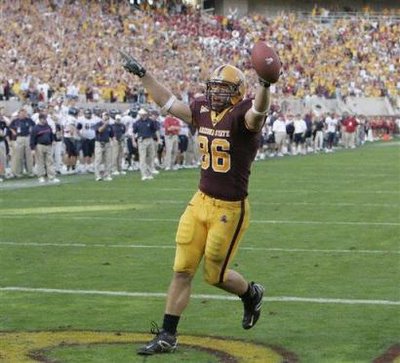
Anyway, a very good season has concluded (overall: 10-2; Pac-10: 7-2), and now it's on to a bowl game (the Fiesta Bowl, insha'allah). (The above photo is of ASU's junior running back Keegan Herring, after scoring a touchdown; credit: The Arizona Republic.)
Update: Twelth-ranked ASU (11th-ranked in the BCS) will be playing #17 Texas in the Holiday Bowl on December 27th. This will be ASU's third Holiday Bowl appearance (where they're 0-2), and their first game ever against Texas. It should be an interesting game. BTW, speaking of rivalries, my high school's football team beat our cross-town rivals, EFA, 41-13, for the third time in four years. Good job, Green Hornets!
February 20, 2006
"Follow the White Rabbit" (or "Why I Took the Red Pill")
 There's an article in the Arizona Republic today about Arizona State University's Memorial Union celebrating its 50th anniversary. Toward the end of the article is an amusing comment by Grady Gammage, Jr., who is the son of Grady Gammage (duh! ;) ), the President of ASU during the 1950s.
 "I cannot tell you that I remember the day of the dedication because I was 3," Gammage said. "But I remember a lot about the Memorial Union early in its life."
Gammage, too, believes the union is more than a building; it is a monument to the collective memories of the campus. He recalled a year when the theme was "Alice in Wonderland."
"All of my friends and I got to dress up as the White Rabbit," Gammage said. "We wore these bunny suits with floppy ears. We were chased by coeds dressed as Alice. When you're in fourth grade, this was hot stuff."
January 28, 2006
In Memoriam
"Uhoh."
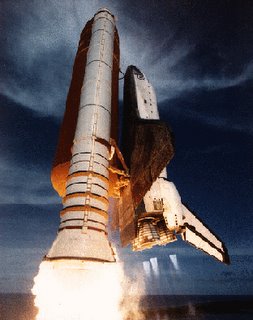
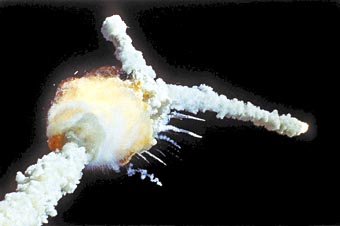
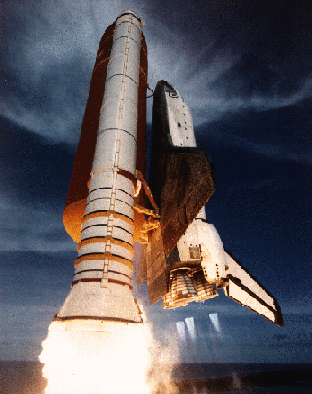
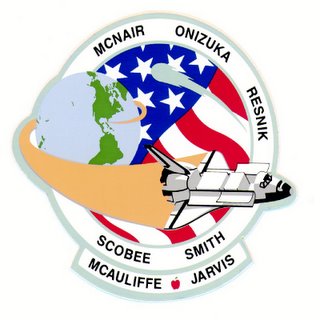 That was the last recorded word of Challenger shuttle pilot Michael J. Smith. Today is the 20th anniversary of the Challenger explosion, and it's sort of hard to believe that that much time has elapsed. This event was one of those "where were you?" moments in my life. The launch of the shuttle happened at 11:38 a.m., and I was attending Arizona State University at the time, two hours to the west. My college roommate, Brian, and I had just woken up, and Brian, who had turned on his TV, told me to come watch. The news broadcast was similar to that of the coverage for 9/11, with the endless repeating of the shuttle blowing up, over and over again, in the frigid, clear blue Florida sky.
As a child, I had always wanted to be an astronaut. I was fascinated by rockets launching and astronauts walking on the moon, and I had really, really wanted to be up there in space with them. When I was in junior high school, we read the short story, The Man Without a Country by Edward Everett Hale. Afterwards, my English teacher had us write an essay, to imagine ourselves being like Philip Nolan, living the rest of our life in a state of exile except that, instead of life aboard a Navy ship, we would live aboard Skylab, the American space station that had been - at the time - recently launched into orbit. Of course, to me, that thought wasn't a penalty, a punishment, but a marvelous idea and I wrote about how my life would be so wonderful if I could live forever aboard Skylab. (Or, at least, until it came down to Earth, burning up in the atmosphere and killing a cow. ;) ) Needless to say, my English teacher didn't appreciate my youthful exuberance. (BTW, a woman from my hometown, Eileen Collins, did become an astronaut and has made several trips into space. I'm very happy for her as she's been able to live out my childhood fantasy. I do wish I could join her for one flight, though. ;) )
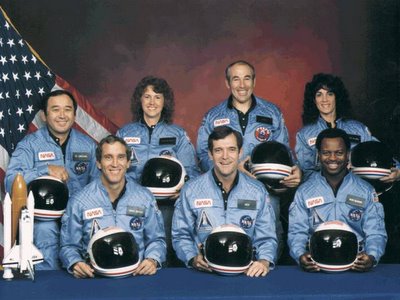
The Challenger 51-L flight was famous for more than just its spectacular demise. This was also the flight of Christa McAuliffe, the teacher from Concord High School (Concord, NH), who had been selected for NASA's Teacher in Space program. McAuliffe, who had beat out over 11,500 other applicants, was scheduled to teach two lessons from the space shuttle. It was largely because of McAuliffe's death, whom the nation had gotten to know so well in the months preceding the launch, that the tragedy of the Challenger explosion seemed to be magnified.
 "You have to dream. We all have to dream. Dreaming is okay. Imagine me teaching from space, all over the world, touching so many people's lives. That's a teacher's dream! I have a vision of the world as a global village, a world without boundaries. Imagine a history teacher making history!"
-- Sharon Christa Corrigan McAuliffe
Just prior to the Challenger tragedy, Voyager 2 had passed by the planet of Uranus, discovering a total of ten small moons between 30 December 1985 and 23 January 1986. These discoveries, significant by themselves (and which would have made big news at any other time), were largely ignored due to Challenger. While there were a number of proposals to have the new moons around Uranus named after the Challenger astronauts (and also that of the dead Apollo 1 astronauts, Roger Chaffee, Ed White, and Gus Grissom), the Challenger crew did have craters on the moon - and some asteroids - named after them.
Today, on the 20th anniversary of the death of the Challenger 51-L crew, I want to close by saying, "You are not forgotten. I honor your courage, and pray that Allah (swt) forgives you your sins and accepts you into Jannah in the Hereafter."
In the memory of Francis R. "Dick" Scobee, Michael J. Smith, Judith A. Resnik, Ellison S. Onizuka, Ronald E. McNair, Gregory Jarvis, and Sharon Christa Corrigan McAuliffe:
Oh! I have slipped the surly bonds of Earth
And danced the skies on laughter-silvered wings;
Sunward I’ve climbed, and joined the tumbling mirth
Of sun-split clouds, —and done a hundred things
You have not dreamed of—wheeled and soared and swung
High in the sunlit silence. Hov’ring there,
I’ve chased the shouting wind along, and flung
My eager craft through footless halls of air....
Up, up the long, delirious, burning blue
I’ve topped the wind-swept heights with easy grace
Where never lark nor even eagle flew—
And, while with silent lifting mind I’ve trod
The high untrespassed sanctity of space,
Put out my hand, and touched the face of God.
"High Flight," John Gillespie Magee, Jr.
 For more links on Challenger 51-L and its crew, please see:
The Crew of the Challenger Shuttle Mission in 1986
Space Shuttle Mission Chronology for Challenger 51-L
JSC Digital Image Collection for STS-51L*
51-L Movies
Joseph Kerwin's report on how the Challenger astronauts died**
President Reagan's Address to the Nation
Senator John Glenn's Remarks at the Memorial Service for Judith Resnik
The Transcript of the Challenger Crew from the Operational Recorder
 That was the last recorded word of Challenger shuttle pilot Michael J. Smith. Today is the 20th anniversary of the Challenger explosion, and it's sort of hard to believe that that much time has elapsed. This event was one of those "where were you?" moments in my life. The launch of the shuttle happened at 11:38 a.m., and I was attending Arizona State University at the time, two hours to the west. My college roommate, Brian, and I had just woken up, and Brian, who had turned on his TV, told me to come watch. The news broadcast was similar to that of the coverage for 9/11, with the endless repeating of the shuttle blowing up, over and over again, in the frigid, clear blue Florida sky.
 As a child, I had always wanted to be an astronaut. I was fascinated by rockets launching and astronauts walking on the moon, and I had really, really wanted to be up there in space with them. When I was in junior high school, we read the short story, The Man Without a Country by Edward Everett Hale. Afterwards, my English teacher had us write an essay, to imagine ourselves being like Philip Nolan, living the rest of our life in a state of exile except that, instead of life aboard a Navy ship, we would live aboard Skylab, the American space station that had been - at the time - recently launched into orbit. Of course, to me, that thought wasn't a penalty, a punishment, but a marvelous idea and I wrote about how my life would be so wonderful if I could live forever aboard Skylab. (Or, at least, until it came down to Earth, burning up in the atmosphere and killing a cow. ;) ) Needless to say, my English teacher didn't appreciate my youthful exuberance. (BTW, a woman from my hometown, Eileen Collins, did become an astronaut and has made several trips into space. I'm very happy for her as she's been able to live out my childhood fantasy. I do wish I could join her for one flight, though. ;) )
The Challenger 51-L flight was famous for more than just its spectacular demise. This was also the flight of Christa McAuliffe, the teacher from Concord High School (Concord, NH), who had been selected for NASA's Teacher in Space program. McAuliffe, who had beat out over 11,500 other applicants, was scheduled to teach two lessons from the space shuttle. It was largely because of McAuliffe's death, whom the nation had gotten to know so well in the months preceding the launch, that the tragedy of the Challenger explosion seemed to be magnified.
 "You have to dream. We all have to dream. Dreaming is okay. Imagine me teaching from space, all over the world, touching so many people's lives. That's a teacher's dream! I have a vision of the world as a global village, a world without boundaries. Imagine a history teacher making history!"
-- Sharon Christa Corrigan McAuliffe
Just prior to the Challenger tragedy, Voyager 2 had passed by the planet of Uranus, discovering a total of ten small moons between 30 December 1985 and 23 January 1986. These discoveries, significant by themselves (and which would have made big news at any other time), were largely ignored due to Challenger. While there were a number of proposals to have the new moons around Uranus named after the Challenger astronauts (and also that of the dead Apollo 1 astronauts, Roger Chaffee, Ed White, and Gus Grissom), the Challenger crew did have craters on the moon - and some asteroids - named after them.
Today, on the 20th anniversary of the death of the Challenger 51-L crew, I want to close by saying, "You are not forgotten. I honor your courage, and pray that Allah (swt) forgives you your sins and accepts you into Jannah in the Hereafter."
In the memory of Francis R. "Dick" Scobee, Michael J. Smith, Judith A. Resnik, Ellison S. Onizuka, Ronald E. McNair, Gregory Jarvis, and Sharon Christa Corrigan McAuliffe:

And danced the skies on laughter-silvered wings;
Sunward I’ve climbed, and joined the tumbling mirth
Of sun-split clouds, —and done a hundred things
You have not dreamed of—wheeled and soared and swung
High in the sunlit silence. Hov’ring there,
I’ve chased the shouting wind along, and flung
My eager craft through footless halls of air....
Up, up the long, delirious, burning blue
I’ve topped the wind-swept heights with easy grace
Where never lark nor even eagle flew—
And, while with silent lifting mind I’ve trod
The high untrespassed sanctity of space,
Put out my hand, and touched the face of God.
"High Flight," John Gillespie Magee, Jr.
 For more links on Challenger 51-L and its crew, please see:
The Crew of the Challenger Shuttle Mission in 1986
Space Shuttle Mission Chronology for Challenger 51-L
JSC Digital Image Collection for STS-51L*
51-L Movies
Joseph Kerwin's report on how the Challenger astronauts died**
President Reagan's Address to the Nation
Senator John Glenn's Remarks at the Memorial Service for Judith Resnik
The Transcript of the Challenger Crew from the Operational Recorder
- 1: There are 250 images in this collection, so it makes sense to change the "Results per Page" number up to 50 or so.
- 2: The Challenger astronauts apparently didn't die due to the blast from the external fuel tank's explosion, but either from a loss of oxygen after the Challenger disintegrated or from the flight cabin's impact into the Atlantic Ocean.
December 24, 2005
Sex on the Brain
Looking at one of my hit counters this morning, I was struck by how many people currently have sex on the brain. Aren't you guys supposed to be celebrating Christmas or something? Ho, ho, ho, and all that?
Out of the past 20 search engine referrals (such as those made by Google, Yahoo, etc.), 13 had something to do with nudity with 2 more being questionable. Of the 13, eight people wanted to see the Indian tennis star, Sania Mirza, naked (what else is new?), two wanted to see nude pictures of coeds from Arizona State University (this is regarding the upcoming Playboy pictorial that will be published next year), and then there was one each for Angela Keathley (the ex-Carolina Panther cheerleader who may or may not have been having lesbian sex in a bar's bathroom stall), a generic "young mother posing nude" (hey, perv, you wanna see the kid too?), and one for "JD erotic photos" (sorry, wrong JD, no erotic photos here). The two that are questionable included one for "sania mirza's skirt" (uh, it looks like any other woman tennis player's skirt?) and another for "texas street korea." The latter is a (in)famous street in the "Russian" neighborhood of Busan, Korea, near some of the piers, where you can find a number of Russian bars, stores, and hookers. (I visited there briefly one night to see what the place was like.)
I've got a few more comments to make regarding what my visitors want (including a survey I took on people looking for information/photos on Sania Mirza), but those will be in later posts, insha'allah.
Out of the past 20 search engine referrals (such as those made by Google, Yahoo, etc.), 13 had something to do with nudity with 2 more being questionable. Of the 13, eight people wanted to see the Indian tennis star, Sania Mirza, naked (what else is new?), two wanted to see nude pictures of coeds from Arizona State University (this is regarding the upcoming Playboy pictorial that will be published next year), and then there was one each for Angela Keathley (the ex-Carolina Panther cheerleader who may or may not have been having lesbian sex in a bar's bathroom stall), a generic "young mother posing nude" (hey, perv, you wanna see the kid too?), and one for "JD erotic photos" (sorry, wrong JD, no erotic photos here). The two that are questionable included one for "sania mirza's skirt" (uh, it looks like any other woman tennis player's skirt?) and another for "texas street korea." The latter is a (in)famous street in the "Russian" neighborhood of Busan, Korea, near some of the piers, where you can find a number of Russian bars, stores, and hookers. (I visited there briefly one night to see what the place was like.)
I've got a few more comments to make regarding what my visitors want (including a survey I took on people looking for information/photos on Sania Mirza), but those will be in later posts, insha'allah.
November 27, 2005
Arizona State University: Truth, Knowledge, A Great Tan!
There was an interesting set of articles in the Arizona Republic the other day about my alma mater, Arizona State University. In one article, it seems that ASU will be listed in the May edition of Playboy magazine for being one of the top ten party schools in the U.S. But the University's President, Michael Crow, isn't terribly happy.
"In ASU's case, the party-school ranking is 'a gross simplification that doesn't have anything to do with who we are and what we are,' Crow says.
"Crow has made an enormous effort to ratchet up the academics. He hired Ed Prescott, who then won the 2004 Nobel Prize in economic sciences. He helped recruit 162 National Merit Scholars to attend ASU last fall. He envisions a 'New American University' that will offer quality education to many and foster economic growth.
"Now comes Playboy's list.
"'How do they really know?' Crow asks. 'How do they really assess that? ASU is a very serious school with very serious students. It's also a place where people have a great time and is a great place to be.'
"The party-school image stems partly from some of ASU's inherent qualities. It's huge, with about 52,000 students on the Tempe campus alone. It's sunny and warm throughout the school year.
"In the Princeton Review, some ASU students describe the school like this:
"It's a place where 'almost everyone is beautiful: tall, blond, skinny, and bronzed. . . . Everyone works out and takes care of their bodies, but at the same time (they know) how to have a good time.' As one student puts it: 'It is rare to find an academically oriented soul on campus.'"
Thus sayeth the Greek freshman from out-of-state who's discovering how to "party" by getting drunk and stoned from his or her similarly-intoxicated Greek brothers/sisters. What a goof!
"Playboy spokeswoman Theresa Hennessey says the 2006 list is different from Playboy's last one in 2002, when ASU was No. 1, or the previous one in 1987, when the Sun Devils were 13th.
"'Others were pollings of students and readers,' she said. 'This time, it was just some editors who thought of some great party schools.'"
In other words, why waste all that money on asking people what they think? We'll just make it up as we go along. A small comfort to Dr. Crow, I imagine.
Of course, party rankings really don't mean all that much:
"'When students are hunting for a university, it's not a significant issue to students if it's on a party list,' Mark Nickel, spokesman for Brown University (33rd on Playboy's 1987 listing of party schools), said.
"But there's another concern about such ratings. John Lucas, a spokesman for the University of Wisconsin-Madison, blames the publications and Web sites for glorifying the party culture.
"'It causes a problem on campus,' Lucas says of Wisconsin's being ranked in the top 10 on some lists. 'It becomes self-fulfilling. Students say, "We need to follow those rankings. We have to drink more, not just three or four, but seven or eight, instead."
University of Wisconsin police have taken 44 students to the emergency room this fall because they were so drunk, Lucas says. That compares with 25 last fall."
On the other hand, the other article in the Arizona Republic backed up some of Dr. Crow's assertion about how Arizona State is becoming a top-notch university:
"Arizona State University is the country's fourth-highest producer of Fulbright scholars among public universities for the current school year.
"And while ASU ranks 13th nationally with 14 students participating in the country's largest international exchange program, the school's acceptance rate - nearly 40 percent - was higher than all Ivy League institutions.
"'It really does send a signal to the country that we are a very serious research university. It shows we have a wonderful faculty and students that are doing interesting things and I think that's important,' said Janet Burke, associate dean for national scholarship advisement and internships at the ASU Barrett Honors College."
Returning to the original article, Labels frustrate ASU, UA: Tempe fights party reputation; Tucson says it's not Dullsville, the Republic concluded by writing:
"For all the ballyhoo about which school is more about partying than academics, a closer examination of ASU and UA [the University of Arizona] finds they look a lot alike.
"For the 2004-05 freshman class, UA accepted 83 percent of applicants, while ASU accepted 86 percent. The average UA freshman's high school GPA was 3.4; ASU's was 3.3. The average SAT scores of the schools differed by only 10 points.
"Guess they'll have to sort out their real differences later tonight on the football field."
Which, of course, ASU won, 23-20. :)
"In ASU's case, the party-school ranking is 'a gross simplification that doesn't have anything to do with who we are and what we are,' Crow says.
"Crow has made an enormous effort to ratchet up the academics. He hired Ed Prescott, who then won the 2004 Nobel Prize in economic sciences. He helped recruit 162 National Merit Scholars to attend ASU last fall. He envisions a 'New American University' that will offer quality education to many and foster economic growth.
"Now comes Playboy's list.
"'How do they really know?' Crow asks. 'How do they really assess that? ASU is a very serious school with very serious students. It's also a place where people have a great time and is a great place to be.'
"The party-school image stems partly from some of ASU's inherent qualities. It's huge, with about 52,000 students on the Tempe campus alone. It's sunny and warm throughout the school year.
"In the Princeton Review, some ASU students describe the school like this:
"It's a place where 'almost everyone is beautiful: tall, blond, skinny, and bronzed. . . . Everyone works out and takes care of their bodies, but at the same time (they know) how to have a good time.' As one student puts it: 'It is rare to find an academically oriented soul on campus.'"
Thus sayeth the Greek freshman from out-of-state who's discovering how to "party" by getting drunk and stoned from his or her similarly-intoxicated Greek brothers/sisters. What a goof!
"Playboy spokeswoman Theresa Hennessey says the 2006 list is different from Playboy's last one in 2002, when ASU was No. 1, or the previous one in 1987, when the Sun Devils were 13th.
"'Others were pollings of students and readers,' she said. 'This time, it was just some editors who thought of some great party schools.'"
In other words, why waste all that money on asking people what they think? We'll just make it up as we go along. A small comfort to Dr. Crow, I imagine.
Of course, party rankings really don't mean all that much:
"'When students are hunting for a university, it's not a significant issue to students if it's on a party list,' Mark Nickel, spokesman for Brown University (33rd on Playboy's 1987 listing of party schools), said.
"But there's another concern about such ratings. John Lucas, a spokesman for the University of Wisconsin-Madison, blames the publications and Web sites for glorifying the party culture.
"'It causes a problem on campus,' Lucas says of Wisconsin's being ranked in the top 10 on some lists. 'It becomes self-fulfilling. Students say, "We need to follow those rankings. We have to drink more, not just three or four, but seven or eight, instead."
University of Wisconsin police have taken 44 students to the emergency room this fall because they were so drunk, Lucas says. That compares with 25 last fall."
On the other hand, the other article in the Arizona Republic backed up some of Dr. Crow's assertion about how Arizona State is becoming a top-notch university:
"Arizona State University is the country's fourth-highest producer of Fulbright scholars among public universities for the current school year.
"And while ASU ranks 13th nationally with 14 students participating in the country's largest international exchange program, the school's acceptance rate - nearly 40 percent - was higher than all Ivy League institutions.
"'It really does send a signal to the country that we are a very serious research university. It shows we have a wonderful faculty and students that are doing interesting things and I think that's important,' said Janet Burke, associate dean for national scholarship advisement and internships at the ASU Barrett Honors College."
Returning to the original article, Labels frustrate ASU, UA: Tempe fights party reputation; Tucson says it's not Dullsville, the Republic concluded by writing:
"For all the ballyhoo about which school is more about partying than academics, a closer examination of ASU and UA [the University of Arizona] finds they look a lot alike.
"For the 2004-05 freshman class, UA accepted 83 percent of applicants, while ASU accepted 86 percent. The average UA freshman's high school GPA was 3.4; ASU's was 3.3. The average SAT scores of the schools differed by only 10 points.
"Guess they'll have to sort out their real differences later tonight on the football field."
Which, of course, ASU won, 23-20. :)

Subscribe to:
Posts (Atom)