Must...buy...Mentos! :)


June 12, 2006
Free Wallpaper @ Firaushah.com
The past week has been somewhat busy for me, in part because I was playing catch-up after the trip Milady and I took last weekend to Kuala Lumpur. The trip was quite nice, alhamdulillah. Milady and I stayed at Le Meridien Hotel, which is just across the street from KL Sentral, the main train station for the city. (Milady and I have always taken the train when going up to KL; while it's a rather slow trip, it's comfortable and the price is *very* reasonable.)
Up in KL, we took quite a few photographs at the various places we visited. For this trip, we visited two masjids: Masjid Putra, which is located in Putrajaya, the administrative capital of Malaysia, and Masjid Blue (it's real name is Masjid Sultan Salahuddin Abdul Aziz Shah, but everyone just calls it the Blue Mosque because the masjid has a blue and white color scheme). Both masjids were very impressive in their architecture and beauty, although I must say that the Blue Mosque was simply stunning. It is, without any question, the most spectacular masjid I have ever been in to date.
 Which leads me to my wallpaper offer: I've created what I hope will be the first of many FREE desktop wallpapers available at firaushah, insha'allah. All I'm asking is that you sign up for the firaushah mailing list. When you sign up, I'll e-mail you with a link to a webpage that will allow you to access the current wallpaper (available in four sizes: 800x600, 1024x768, 1152x864, and 1280x1024), insha'allah. This month's wallpaper is from one of my photos taken at the Blue Mosque. The wallpaper came out beautifully (in my not so humble opinion ;) ), and gives you an idea of both the size and beauty of the masjid's dome.
Up in KL, we took quite a few photographs at the various places we visited. For this trip, we visited two masjids: Masjid Putra, which is located in Putrajaya, the administrative capital of Malaysia, and Masjid Blue (it's real name is Masjid Sultan Salahuddin Abdul Aziz Shah, but everyone just calls it the Blue Mosque because the masjid has a blue and white color scheme). Both masjids were very impressive in their architecture and beauty, although I must say that the Blue Mosque was simply stunning. It is, without any question, the most spectacular masjid I have ever been in to date.
 Which leads me to my wallpaper offer: I've created what I hope will be the first of many FREE desktop wallpapers available at firaushah, insha'allah. All I'm asking is that you sign up for the firaushah mailing list. When you sign up, I'll e-mail you with a link to a webpage that will allow you to access the current wallpaper (available in four sizes: 800x600, 1024x768, 1152x864, and 1280x1024), insha'allah. This month's wallpaper is from one of my photos taken at the Blue Mosque. The wallpaper came out beautifully (in my not so humble opinion ;) ), and gives you an idea of both the size and beauty of the masjid's dome.
June 1, 2006
Abayas Turning Trendy
 There's an article from the Associated Press about how abayas in the Gulf states are becoming trendy. (Actually, I suspect that abayas have long been trendy, just that no Western reporter has noticed until now. Anyhoo...) One interesting passage, near the end of the article:
But advocates of fancier versions are convinced they can combine fashion and modesty.
...
Never mind that his elegant consort, sporting an abaya decorated with golden metal and matching head cover, could cause more heads to turn than a less attractive woman in a short skirt.
"Abayas are now both decent and fashionable. Everyone follows the fashion nowadays," Mohammad said.
This is what Milady and I believed in when we started firaushah, that Muslimahs can wear modest clothing that is beautiful and fashionable.
Strike back at these ignorant non-Muslims who say you are oppressed! Wear beautiful clothing - clothing that's better looking than theirs - and ask if "oppressed" women wear as fashionable of clothing as your own.
May 31, 2006
Transformer
One more post before I get to work...
Living in S'pore, there are commercials here promoting the Singapore Armed Forces (SAF), just as you would find in the U.S. The ad agencies that work for the SAF, fortunately, do a very nice job and I've actually enjoyed a number of SAF commercials over the years (even though I'm too old really to be humping around the obstacle courses with the kids here ;) ). One commercial that I like, Symphony of Strength, I can only find on the MinDef website as streaming video. The other video, below, is a Navy commercial (the commercials for the Navy here have been particularly creative over time).
Living in S'pore, there are commercials here promoting the Singapore Armed Forces (SAF), just as you would find in the U.S. The ad agencies that work for the SAF, fortunately, do a very nice job and I've actually enjoyed a number of SAF commercials over the years (even though I'm too old really to be humping around the obstacle courses with the kids here ;) ). One commercial that I like, Symphony of Strength, I can only find on the MinDef website as streaming video. The other video, below, is a Navy commercial (the commercials for the Navy here have been particularly creative over time).
Watch out for them ducks, ET!
 SETI's got it all wrong: we shouldn't be looking out into space to find ETs, they're already here. And, what's more, the damn ETs are being eaten by ducks! Don't think so? Look at the photograph. The original caption for the photo:
This undated photo provided by the International Bird Rescue Research Center, shows an X-ray taken Sunday, May 21, 2006, of an injured duck with a broken wing. The International Bird Rescue Research Center in Cordelia. Calif., plans to raise funds with an unusual duck X-ray, which they say shows the clear image of what appears to be the face, or head, of an extraterrestrial alien in the bird's stomach. Unfortunately, the duck died quickly and quietly of its injuries.
May 30, 2006
Don't Hate Her Because She's Beautiful ... and Wears a ... Tudung

What follows is a comment I made on another website, called Cultural Kitchen. They themselves are reacting to an exhibit at the Amsterdam Historical Museum called "My Headscarf."
The title of the Cultural Kitchen article is "Don't Hate Her Because She's Beautiful ... and Wears a Burqa." One of the small annoyances I've been having with non-Muslims lately (and the degree of annoyance has been growing larger recently) is that non-Muslims don't use Muslim terminology properly. My initial point in the comment was that none of the scarves in the above picture are burqas, that they are all hijabs (or tudungs, depending on where you live in the world).
But I see this improper use of terminology as being symptomatic of a larger problem: that non-Muslims, being largely ignorant of Islam and more or less unwilling to learn more about Islam and the lives of Muslims, use Islamic terminology in a very willy-nilly fashion, not really knowing what they're talking about, and exposing their ignorance to those of us who do know the terminology. (My hackles are raised even more with the improper use of "Jihad.")
But Cultural Kitchen's basic premise, as expressed in their title, is a correct one and I made that point (insha'allah) in the second paragraph.
All of the pictures and styrofoam "models" are wearing hijabs (or tudungs, as they're called here in SE Asia). A burqa is a type of all-concealing robe that has a little "grilled window" that allows the woman to see through and tends to be worn only by Muslim women in central Asia (e.g., Afghanistan). The hijab and tudung, however, are worn by Muslim women most everywhere else.
I agree with your basic sentiment, though. Don't hate her because she's beautiful and wears a tudung. My wife (we are both Muslims) has been wearing a tudung since long before we met and, of course, I think she looks beautiful either with or without the scarf. But she doesn't wear the tudung to please me (although that's a side benefit for myself), she wears it to please Allah (swt), because she tries to be a proper Muslim. And that, I feel, is the problem with many non-Muslims, such as the Dutch who are proposing this "ban." They don't seem to be willing to look at the issue from our perspective. They're merely worried about whether the Muslim community will integrate into their culture. That's a legitimate concern for any country, of course, but it's not *our* primary concern. Like Hebrew National said in their hot dog commercials, "we answer to a higher authority." Trying to ban a religious covering like the hijab or tudung is only setting one's self up for failure, because we will look at the two authors of the law (man vs. Allah (swt)), and decide accordingly.
May 29, 2006
May 28, 2006
10 Things I Hate About Commandments
Terrible title (astaghfirullah!), but an amusing parody... Answers the burning (bush) question: "How would Cecil B. DeMille's The Ten Commandments be marketed if the movie came out today?"
May 27, 2006
How Much Oil Does America Import?
 Ever since I wrote Oil: America's Smack back in February, I've had a fairly steady stream of visitors asking the same question: how much oil does America import? I touched on this answer in my Smack post, but the question is worth looking into once more.
Every year, the United States pumps up some of its own oil (called "Field Production" according to the DoE) and imports the rest. Not surprisingly, American field production has been dropping over time. In the year 2000, American commercial field production made up 33.51% of its total supply of crude oil, while imports made up 52.21%. In 2005, those same percentages were 28.44% and 55.85%, respectively. And, of course, there's no reason to expect either of these trends not to continue going down and up, respectively, in the near future.
The United States has been importing oil since at least 1910 (according to DoE statistics), when a mere 557 thousand barrels of oil were brought into the country. Last year, the U.S. imported 3,670,403 thousand barrels of oil. Of those 3.67 billion barrels of oil, the U.S. imported from a total of 42 different countries. The top 5 importing countries were Canada (16.34%), Mexico (15.42%), Saudi Arabia (14.30%), Venezuela (12.24%), and Nigeria (10.54%), for a total of 68.84% of all American imports. In contrast, imports from countries 6 through 10 (Iraq, Angola, Ecuador, Algeria and the United Kingdom) make up only 16.84% of the total, with countries 11 through 42 making up the remaining 14.33%.
Looked at another way, only 21.69% of America's oil imports come from the Persian Gulf region. Per the DoE, the Persian Gulf includes Bahrain, Iran, Iraq, Kuwait, Qatar, Saudi Arabia, and the United Arab Emirates; however, Iran and Qatar export no oil to the United States. If we compare imports from OPEC countries vs. non-OPEC countries, we find that non-OPEC countries are now in the majority, 52.64% vs. 47.36%. And, with the exception of one year, 2001, non-OPEC countries have been in the ascendancy since 1994.
Conclusions/Predictions:
1. American field production will probably go below 25% of its total annual supply within the next five years.
2. In that same time frame, imports will probably be in the high 50s percentage (perhaps 58-59%).
3. America will continue to seek the majority of its oil from non-OPEC countries, such as Canada and Mexico, if only to avoid being as dependent on OPEC countries as they have been in the past. However, this will probably turn out to be a pipe dream in the long run unless Canadian oil reserve estimates turn out to be near the high end. (Estimates for Canada's proven oil reserves ranges from 4.7 billion barrels (World Oil) to 14.803 billion barrels (BP Statistical Review) to 178.792 billion barrels (Oil & Gas Journal). Obviously, this extremely wide range of guesses shows that no one truly knows how much oil Canada has.)
4. Persian Gulf oil, which has ranged between 19.81% and 28.56% of all U.S. imports since 1996, will probably continue to hover in the high teens-low 20s, despite President Bush's goal to cut American consumption of Middle Eastern oil by 75% by 2025, per the latest State of the Union address.
References:
US Crude Oil Supply and Disposition (DoE)
US Crude Oil Imports by Country of Origin (DoE)
World Proved Reserves of Oil and Natural Gas, Most Recent Estimates
Update: I've written an updated post to this; please see Update: How Much Oil Does America Import.
Note: Despite the age of this article, it remains extremely popular, currently getting over 20% of all my hits on a daily basis. Since I wrote this post, I've written a number of other articles on oil. You might want to check out the following (so far to date; the most recent are at the top):
And over at one of my other blogs:
I hope to have a number of other posts like the one above at the new blog, J2TM, in the near future.
May 26, 2006
Animusic Pipe Dreams I and II
I just found out about these music videos from my Alan Parsons' e-mail list. Both videos are highly imaginative in their mixing of music and computer graphics. The songs played in the two videos are different from each other (although the "layout" of the instruments is the same), so be sure to watch both. The run time for Pipe Dreams I (above) is 3:27; Pipe Dreams II (bottom) is 3:55. Enjoy!
There are a number of other Animusic videos available at Youtube. Check them out here.
There are a number of other Animusic videos available at Youtube. Check them out here.
Islam at a Glance
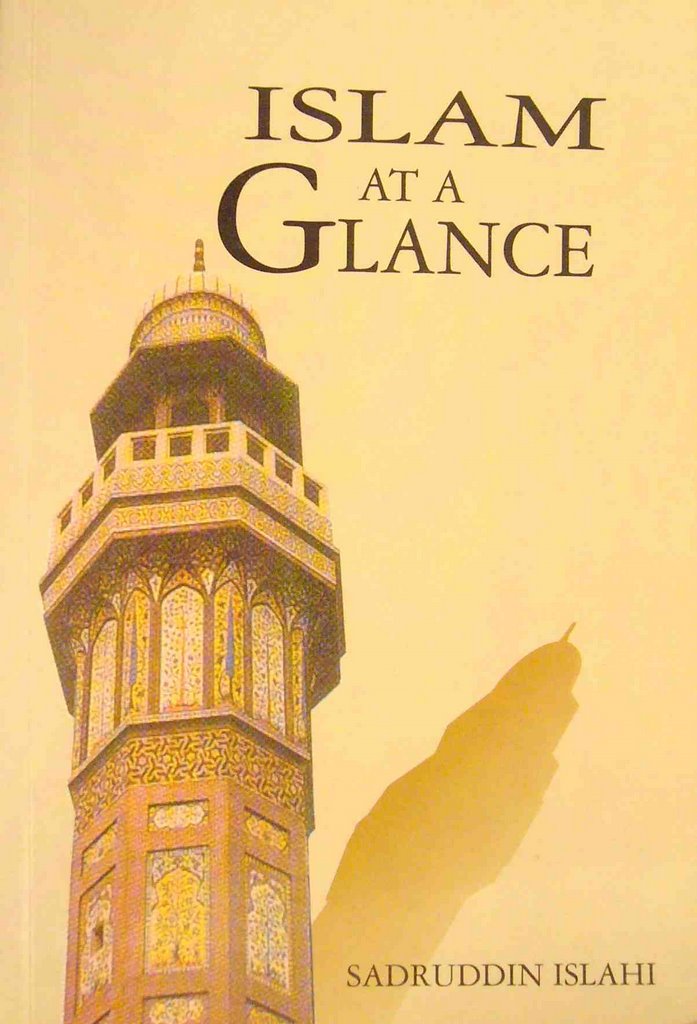 Sadruddin Islahi's Islam at a Glance (Translated by M. Zafar Iqbal)
Islam at a Glance is a primer on Islam. The book covers and explains intelligently the concept and meaning of Islam by focusing on its fundamental beliefs and practices - such as belief in God, the Afterlife, Angels, Books, Prophets and the fundamental duties known as the Pillars of Islam. Objectives of Prayer, Fast, Zakat, Hajj - the Pillars of Islam - have been explained in such detail so as to integrate their relationship with a way of life which is Islam. It also covers the principles behind...[more]
May 25, 2006
Imam Ghazzali's Ihya Ulum-Din (The Book of Worship), Volumes I-IV
 Imam Ghazzali's Ihya Ulum-Din (The Book of Worship), Volumes I-IV
This book, "Ihya Ulum-Id-Din" (Revival of Religious Learnings), is the masterpiece work of the famous Persian scholar Imam Ghazzali who has been honored as "Hujjatul Islam," the Proof of Islam. This book is classified into four volumes - Worship, Worldly Usages, Destructive Evils, and Constructive Virtues. Each volume has been further divided into ten chapters.
The subjects are well arranged like a law book or a medical book. The first two volumes speak about... [more]
May 24, 2006
Big Dog Gets Barked At
 I had an odd experience tonight. Milady had to go to the ATM across the street from our flat and I walked over there with her. As she was waiting in line to get some money out, this very elderly Chinese woman was walking along the path, speaking very loudly to no one in particular. Milady beckoned me over.
 "That lady is crazy."
"No kidding." Anyone could see that.
And, of course, the inevitable happened: the old woman walked past and started talking to me.
Actually, "talking" is a bit of an understatement in this case. "Scold" is perhaps a better word. This woman ranted on for about two minutes in Chinese, which I don't understand at all ("sie sie," or "thank you" is about all I can manage). According to Milady, the old woman started talking about why I was standing where I was and then wondered why I wasn't talking back to her...duh! And while she continued her scolding, other people (mostly Chinese) walked by with smirks and twinkles in their eyes. I could only shrug my shoulders and try to ignore this woman until she moved on, which, of course, she did, continuing her monologue to no one in particular.
Milady was terribly amused by the whole affair and we've talked about it off-and-on this evening. To her, this was a case of the little dog barking at the big dog. (I am a big guy, and this woman was very small, thin and hunched over; she may have osteoporosis.) But I did try to be polite by not reacting to her behavior. Confucianism is widespread throughout Asia and it didn't hurt, in my mind, to grin and bear her "barking."
Woof! :)
Update: A few weeks ago, Milady and I were walking to the parking garage early one morning. We passed by an old Chinese woman and Milady asked, "Did you recognize her?" When I said that I hadn't, Milady said, "That's 'little dog.'" Aaah! :)
Islam: Faith and Practice
 Mahmoud M. Ayoub's Islam: Faith and Practice
What is Islam? Is it just a set of rituals or does it have a philosophy all its own? Islam and Muslims are often in the news but does the non-Muslim really understand what Islam stands for?
In Islam: Faith and Practice, Mahmoud Ayoub presents the Islamic faith as Muslims understand it. The book is divided into three parts. The first deals with [the] Islamic faith and its basis. The second part of the book is concerned with... [more]
Extremism Isn't Islamic Law
One of the very few topics I strongly disagree with my ustaz (religious teacher) about is the issue of what should be done with apostates. I am of the opinion that apostates should be left alone (for the most part) in this world because, as Allah (swt) says in the Qur'an, leave the punishment of the unbelievers to Him (73:11 and 74:11) as, insha'allah, any punishment of His will be far worse than anything we could do ourselves.
Today, the Washington Post has an article by Kyai Haji Abdurrahman Wahid, the former President of Indonesia on this topic that I thought is worth sharing.
For a few days this year the world's media focused an intense spotlight on the drama of a modern-day inquisition. Abdul Rahman, a Muslim convert to Christianity, narrowly escaped the death penalty for apostasy when the Afghan government -- acting under enormous international pressure -- sidestepped the issue by ruling that he was insane and unfit to stand trial. This unsatisfactory ruling left unanswered a question of enormous significance: Does Islam truly require the death penalty for apostasy, and, if not, why is there so little freedom of religion in the so-called Muslim world?
The Koran and the sayings of the prophet Muhammad do not definitively address this issue. In fact, during the early history of Islam, the Agreement of Hudaibiyah between Muhammad and his rivals stipulated that any Muslim who converted out of Islam would be allowed to depart freely to join the non-Muslim community. Nevertheless, throughout much of Islamic history, Muslim governments have embraced an interpretation of Islamic law that imposes the death penalty for apostasy.
It is vital that we differentiate between the Koran, from which much of the raw material for producing Islamic law is derived, and the law itself. While its revelatory inspiration is divine, Islamic law is man-made and thus subject to human interpretation and revision. For example, in the course of Islamic history, non-Muslims have been allowed to enter Mecca and Medina. Since the time of the caliphs, however, Islamic law has been interpreted to forbid non-Muslims from entering these holy cities. The prohibition against non-Muslims entering Mecca and Medina is thus politically motivated and has no basis in the Koran or Islamic law.
In the case of Rahman, two key principles of Islamic jurisprudence come into play. First, al-umuru bi maqashidiha ("Every problem [should be addressed] in accordance with its purpose"). If a legal ordinance truly protects citizens, then it is valid and may become law. From this perspective, Rahman did not violate any law, Islamic or otherwise. Indeed, he should be protected under Islamic law, rather than threatened with death or imprisonment. The second key principle is al-hukm-u yadullu ma'a illatihi wujudan wa adaman ("The law is formulated in accordance with circumstances"). Not only can Islamic law be changed -- it must be changed due to the ever-shifting circumstances of human life. Rather than take at face value assertions by extremists that their interpretation of Islamic law is eternal and unchanging, Muslims and Westerners must reject these false claims and join in the struggle to support a pluralistic and tolerant understanding of Islam.
All of humanity, whether Muslim or non-Muslim, is threatened by the forces of Islamist extremism. It is these extremists, masquerading as traditional Muslims, who angrily call for the death of Abdul Rahman or the beheading of Danish cartoonists. Their objective is raw political power and the eventual radicalization of all 1.3 billion Muslims worldwide. Western involvement in this "struggle for the soul of Islam" is a matter of self-preservation for the West and is critical given the violent tactics and strength of radical elements in Muslim societies worldwide.
Muslim theologians must revise their understanding of Islamic law, and recognize that punishment for apostasy is merely the legacy of historical circumstances and political calculations stretching back to the early days of Islam. Such punishments run counter to the clear Koranic injunction "Let there be no compulsion in religion" (2:256).
People of goodwill of every faith and nation must unite to ensure the triumph of religious freedom and of the "right" understanding of Islam, to avert global catastrophe and spare millions of others the fate of Sudan's great religious and political leader, Mahmoud Muhammad Taha, who was executed on a false charge of apostasy. The millions of victims of "jihadist" violence in Sudan -- whose numbers continue to rise every day -- would have been spared if Taha's vision of Islam had triumphed instead of that of the extremists.
The greatest challenge facing the contemporary Muslim world is to bring our limited, human understanding of Islamic law into harmony with its divine spirit -- in order to reflect God's mercy and compassion, and to bring the blessings of peace, justice and tolerance to a suffering world.
The writer is a former president of Indonesia. From 1984 to 1999 he directed the Nadhlatul Ulama, the world's largest Muslim organization. He serves as senior adviser and board member to LibForAll Foundation, an Indonesian- and U.S.-based nonprofit that works to reduce religious extremism and terrorism.
Today, the Washington Post has an article by Kyai Haji Abdurrahman Wahid, the former President of Indonesia on this topic that I thought is worth sharing.
For a few days this year the world's media focused an intense spotlight on the drama of a modern-day inquisition. Abdul Rahman, a Muslim convert to Christianity, narrowly escaped the death penalty for apostasy when the Afghan government -- acting under enormous international pressure -- sidestepped the issue by ruling that he was insane and unfit to stand trial. This unsatisfactory ruling left unanswered a question of enormous significance: Does Islam truly require the death penalty for apostasy, and, if not, why is there so little freedom of religion in the so-called Muslim world?
The Koran and the sayings of the prophet Muhammad do not definitively address this issue. In fact, during the early history of Islam, the Agreement of Hudaibiyah between Muhammad and his rivals stipulated that any Muslim who converted out of Islam would be allowed to depart freely to join the non-Muslim community. Nevertheless, throughout much of Islamic history, Muslim governments have embraced an interpretation of Islamic law that imposes the death penalty for apostasy.
It is vital that we differentiate between the Koran, from which much of the raw material for producing Islamic law is derived, and the law itself. While its revelatory inspiration is divine, Islamic law is man-made and thus subject to human interpretation and revision. For example, in the course of Islamic history, non-Muslims have been allowed to enter Mecca and Medina. Since the time of the caliphs, however, Islamic law has been interpreted to forbid non-Muslims from entering these holy cities. The prohibition against non-Muslims entering Mecca and Medina is thus politically motivated and has no basis in the Koran or Islamic law.
In the case of Rahman, two key principles of Islamic jurisprudence come into play. First, al-umuru bi maqashidiha ("Every problem [should be addressed] in accordance with its purpose"). If a legal ordinance truly protects citizens, then it is valid and may become law. From this perspective, Rahman did not violate any law, Islamic or otherwise. Indeed, he should be protected under Islamic law, rather than threatened with death or imprisonment. The second key principle is al-hukm-u yadullu ma'a illatihi wujudan wa adaman ("The law is formulated in accordance with circumstances"). Not only can Islamic law be changed -- it must be changed due to the ever-shifting circumstances of human life. Rather than take at face value assertions by extremists that their interpretation of Islamic law is eternal and unchanging, Muslims and Westerners must reject these false claims and join in the struggle to support a pluralistic and tolerant understanding of Islam.
All of humanity, whether Muslim or non-Muslim, is threatened by the forces of Islamist extremism. It is these extremists, masquerading as traditional Muslims, who angrily call for the death of Abdul Rahman or the beheading of Danish cartoonists. Their objective is raw political power and the eventual radicalization of all 1.3 billion Muslims worldwide. Western involvement in this "struggle for the soul of Islam" is a matter of self-preservation for the West and is critical given the violent tactics and strength of radical elements in Muslim societies worldwide.
Muslim theologians must revise their understanding of Islamic law, and recognize that punishment for apostasy is merely the legacy of historical circumstances and political calculations stretching back to the early days of Islam. Such punishments run counter to the clear Koranic injunction "Let there be no compulsion in religion" (2:256).
People of goodwill of every faith and nation must unite to ensure the triumph of religious freedom and of the "right" understanding of Islam, to avert global catastrophe and spare millions of others the fate of Sudan's great religious and political leader, Mahmoud Muhammad Taha, who was executed on a false charge of apostasy. The millions of victims of "jihadist" violence in Sudan -- whose numbers continue to rise every day -- would have been spared if Taha's vision of Islam had triumphed instead of that of the extremists.
The greatest challenge facing the contemporary Muslim world is to bring our limited, human understanding of Islamic law into harmony with its divine spirit -- in order to reflect God's mercy and compassion, and to bring the blessings of peace, justice and tolerance to a suffering world.
The writer is a former president of Indonesia. From 1984 to 1999 he directed the Nadhlatul Ulama, the world's largest Muslim organization. He serves as senior adviser and board member to LibForAll Foundation, an Indonesian- and U.S.-based nonprofit that works to reduce religious extremism and terrorism.
May 23, 2006
Comet Schwassmann-Wachmann 3 Passing by the Earth


Above is a time-lapse movie of Fragment B from Comet Schwassmann-Wachmann 3. I had written about Comet SW3 ten days ago, mentioning that this comet had broken up into a large number of fragments. Fragment B is one of the bigger pieces from that breakup. What I find interesting about this movie is that the motion of the comet in front of the stars is quite obvious. In the past, when I had observed comets in the sky, the apparent motion of the comet was never as dynamic as in this movie; you could see the comet moving night-by-night as it swung around the Sun. Here, though, the motion is very dramatic: the entire video was filmed in one night.
(The apparent motion against the stars is due to the fact that Comet SW3 has been fairly close to the Earth, about 25 times the distance between the Earth and Moon; that's close in astronomical terms.)
If you have any problems in viewing the movie, click on the title link.
May 22, 2006
Veritas vos liberabit
 This was amusing. Apparently the youth of America don't attend college to open their minds, to be introduced to differing perspectives, or to learn to think critically. No, today, they go to colleges merely to have their prejudices confirmed, and heaven help those who tell them otherwise.
After 34 years of college teaching, I thought I had heard just about every imaginable student complaint. Last week, however, a freshman in my 300-seat US History Since 1865 course came in to discuss her exam with one of the graders and proceeded to work herself into a semi-hissy over the fact that we had spent four class periods (one of them consisting of a visit from Taylor Branch) discussing the civil rights movement.
"I don't know where he's getting all of this," she complained, "we never discussed any of this in high school." One might have let the matter rest here as simply an example of a high school history teacher's sins of omission being visited on the hapless old history prof. had the student not informed the TA in an indignant postcript, "I'm not a Democrat! I don't think I should have to listen to this stuff!"
Given the current student and, in some places, administrative, pressures to put absolutely everything -- notes, study guides, all potential exam questions and answers, etc. -- on the Web, I can envision the day when the Web pages for our classes might read: "In order to insure that the professor's lectures will not offend your political sensibilities or challenge any of your other beliefs and perceptions in any way, please indicate by clicking the appropriate box below whether you prefer the Republican or Democratic version of this course."
May 21, 2006
Sale on Firaushah.com
 I'm happy to announce that the new and improved website of firaushah.com is up and running. For a couple weeks now I've been working on this new version of our website, which is why I haven't been blogging as often recently. The website has been completely revamped and, of course, I'll continue to work on it so as to add new products.
Speaking of new products, we've started to sell books as well. My ustaz has a number of books he's asked me to sell for him, and I'm happy to do so. One of the books, "Muhammad: The Ideal Prophet," I mentioned in a number of posts last year around Ramadhan (in my Dunner's Learn About Islam blog). It's a very interesting book, and I highly recommend it. We've got lots of copies, so "die die must buy" (i.e., "you absolutely must buy") as we say here in S'pore. Insha'allah, we'll also add some Bahasa Malayu books to the website in a few days (my ustaz has the books, I just need to finish writing up the appropriate webpages).
Now, to celebrate the new website, firaushah.com is going to hold a SALE. Here's the deal:
If you are on any of my blogrolls OR if you've already listed firaushah.com on your blogroll, we'll give you $10 off on any of our Sparkly tudungs. (These are really beautiful - die die must buy!)
If I'm not currently on your blogroll but you're willing to put firaushah.com on now, we'll give you the $10 off on any of the Sparkly tudungs as well.
Finally, if you let your internet friends now about this SALE and they put firaushah.com on their blogroll and tell me that you recommended them, I'll give them the $10 off and you $20 off on any of the Sparkly tudungs.
This SALE is only through the end of June so don't wait!
May 19, 2006
U R a Brand!
 There's an interview with Catherine Kaputa on Tom Peter's website. Kaputa is the author of a recent book, "U R a Brand! How Smart People Brand Themselves for Business Success." While a lot of the interview is interesting, I've excerpted Kaputa's ten "self-branding strategies" below, which I think are very good ideas as to how we can improve our own personal "brand." I've also included the digressions (in red) the interviewer ("Q") and Kaputa ("CK") had as they discussed her strategies; I felt they helped to expand on some of the points Kaputa made.
Self Branding Strategies:
1. Be the First
2. Be the Leader
3. Take the Anti-leader Position
4. Own an Attribute
5. Use a Magic Ingredient or Invent a New Process
6. Be the Expert
7. Be Preferred
8. Set a High Price
9. Use Your Special Heritage
10. Own a Cause
Strategy #1: Be the First
This is the most powerful strategy because the first brand is generally the market leader. In the product world this means creating a new product, or breaking new ground.
You can see it in the business world too. Michael Dell, for example, created a new market, a new category, as the leading direct marketer of computers. And he has a strong self brand as an innovator. Being the first seems formidable, but is something that anybody could do if you slice up the market narrowly enough. It's really about dissecting the market in a way that creates a new area where you can be first. It's certainly easier if you're an entrepreneur to execute that strategy, although I've seen it happen within companies, where somebody created a new kind of product or a new target market.
Strategy #2: Be the Leader
Positioning yourself as the leader has a halo effect. Most people feel that if you're the leading brand in a category, you must be the best brand. That's the association in people's minds. You garner a lot of business because of the perception, the connection people make between something being the leader and being the best. I talk in the book about leaders like Jack Welch and how it's important to lead with ideas and lead by example.
Strategy #3: Take the Anti-leader Position
For every Microsoft, there's an Apple. For every General Motors, there's a VW; a competitor that takes the opposite attitude of the leader. The leader is big, you're small and nimble, they're out of touch, you're cutting edge, they're bureaucratic, and you're entrepreneurial.
Americans have an emotional connection with underdogs. It's a powerful position. Look at Richard Branson. His quirky, anti-leader approach is "We do it differently than the leader does it in this category."
Q: That brings to mind a commercial from my childhood. Was it Hertz?
CK: It was Avis, a classic anti-leader. "We try harder. We're number two." To be honest with you, I usually travel with Avis because that appeals to me. Whether they try harder or not, it really strikes a chord in people, to root for somebody that's trying to be number one.
Strategy #4: Own an Attribute
This is the most common positioning strategy for brands. When you look at the car category, Mercedes-Benz owns the attribute of prestige, BMW is driving performance, Subaru is ruggedness, and Volvo is safety. Look at your industry or category—what are the important attributes? Who owns what? As a person, look at—who are your key competitors? Who owns what in terms of attributes? Is there an attribute that you can own?
I give some examples in the book of clients that wanted to own an attribute. A client named Benjamin wanted to own the attribute of accountability. He was in a very large, creative company in the entertainment industry. He was a creative business person as were many of his colleagues. He wanted to be known for accountability and follow through, a trait that helped him differentiate himself because not many of his colleagues had that trait.
Strategy #5: Use a Magic Ingredient or Invent a New Process
Many early packaged goods or patent medicines were built on this idea of a "magic ingredient." Today, people can use this magic ingredient or new process strategy. Obviously, people that are consultants, doctors, researchers, or scientists who use processes can develop new processes. Look at diet doctors like Dr. Arthur Agatston, creator of the South Beach Diet, what they do is create a "new process."
Of course, once this new process is out there, everybody copies it. But you have an advantage because you are the one associated with the new process.
Q: You can't take process seriously after the David Mamet movie, The Spanish Prisoner.
CK: Cooks are all about that. In the book, I talk about how chefs used to be work-a-day people until the celebrity chef came along. I marvel at them all now. They're great self-branders. It's all based on a process for cooking, or putting things together in a different way, this new process or magic ingredient kind of idea. They look at what other people do, add a little bit of their own style—preferred ingredients and cooking process—and create success. Their personality is part of it as well.
Strategy #6: Be the Expert
A big point of branding is that it's not smart to be a jack-of-all-trades. You need to be known for something. Be very focused; focus is powerful. This is the strategy that I've adopted, which is to be the expert. It's not just self-branding; it's really the branding space. The thing that's different about the way I approach it is that I'm a brand consultant that works with a company's products and people. Most people just do the people part or they just do a company's brand strategy.
I was amazed when I read in Barbara Corcoran's book (Initially published as "Use What You've Got, and Other Business Lessons I Learned from My Mom" with a title change in the paperback edition to "If You Don't Have Big Breasts, Put Ribbons on Your Pigtails: And Other Lessons I Learned from My Mom") that she had only sold about 12 properties when she put out The Corcoran Report on real estate in Manhattan. It made the front page of the New York Times business section on Sunday. In New York, the real estate market has always been very secretive. They don't have an MLS [Multiple Listing Service]. She published, and continues to publish what the average price of an apartment is on the East Side, West Side, Downtown, or Midtown. Suddenly she was the real estate expert in New York, and she'd only sold a dozen properties. Obviously, she's a self-branding genius to have accomplished what she did, as well as a savvy businessperson.
Q: I recently interviewed the author of Future Shop, a book about the auction culture. He has an interesting section about the secondary market for cars; the used car industry. He mentioned Kelley, who started the Blue Book as a way to help his used car sales. But in time, the Blue Book overtook his used car business. It's one of those instances of the information surrounding the product and the sales becoming much more valuable than the sales. So I could see a future for Barbara Corcoran where it's about selling the information and not selling the properties any longer.
CK: Corcoran is doing just that. She sold her real estate company, and she's starting a production company. The media has a craving for experts on all kinds of topics. PR and media exposure can be a very important angle to the expert strategy. Writing reports, or publishing a book about your area of expertise are both good ways to gain visibility.
Strategy #7: Be Preferred
This is really user positioning. You want to be preferred by a certain target audience and define yourself that way. For example, you become the Wall Street broker or financial consultant who specializes in women, or specializes in advertising people. You then begin to understand your audience very well and develop advice and services tailored to the needs of that specific group. That becomes your value added and your target group will refer you a lot, so it becomes a self-fulfilling prophecy.
Strategy #8: Set a High Price
There are all kinds of stories of the $100 handbag that no one bought, but when it had a $500 price tag on it, it flew out the door. There's always that perception, that if you're a $500 an hour consultant, you're better than a $100 an hour consultant, or why would you charge so much?
A big part of this strategy is that you don't discount. We all have a desire for luxury goods. People recognize that if they're paying top price, they're getting the best. It has a certain cachet.
Q: It's a built-in self-validation; if I can afford to pay this, I must be fabulous.
CK: Yeah. It's a powerful strategy to have, particularly if you're a consultant or in the professions. Pricing yourself at the upper end of the market can be very successful, because a lot of people are attracted to people that charge a lot. Certain executives price themselves in a certain category. If you don't have that mindset you're never going to make that kind of salary.
Q: So you've really got to stay on your toes with that strategy.
CK: Yeah. Well, look at the salaries of CEOs in this country; they're enormous. Not everybody feels they're worth it. That has to be a big part of it, feeling that you're worth it.
Strategy #9: Use Your Special Heritage
You see this in the product world, emphasizing the heritage of the product. Stolichnaya is an example. With cars, you see the emphasis on where they're made, such as German heritage. For people, if you have a name like Bush, Kennedy, Rockefeller, or Hilton, you have one up on the rest of us. It can really boost a career. I've been in many jobs where I've seen nepotism. Look at all the celebrity magazines in this country. People are very attracted to famous family heritages or celebrity status.
There are all kinds of heritage. Certainly, if you have experience working at Procter & Gamble that heritage is a big boost to your personal brand if you continue to work in packaged goods or move to other areas. People will be impressed with the marketing training you had at P&G. If you're an investment banker, and you worked at Goldman Sachs, people assume you're the best.
Q: So don't burn your bridges, because wherever you have been in the past might have some advantage for your future, right?
CK: Exactly. It's important to think of that when you're getting a first or second job. If you're offered a job at one of these top places, it's very helpful for whatever you do later on to have that as part of your credentials. It will differentiate you and people will make a lot of assumptions. The assumptions may be true or they may not be true.
I went to graduate school at Harvard, because I knew getting a Ph.D. from the University of Washington where I received an M.A. would not help me get many jobs. Being a Japanese art historian in the United States is a very tough career. I knew that I'd have a much better shot at getting a job if I had the Harvard brand. I'm the same person, whether I got the Ph.D. here or there, but the whole outcome of my career and life is day and night.
Plus if you're in a place like Harvard, you get all these opportunities to work on exhibitions and book projects that lead to connections and experience. Obviously, a big thing I talk about in the book is networks and this advantage of knowing people. In advertising, you develop a media plan; with Brand You, your media plan is the people that you know and come in contact with.
Strategy #10: Own a Cause
I think that a lot of us are driven to do something meaningful and significant. It's not all about money. Look at Bono, he's very involved in a cause. I think it's really helped his brand a lot. He's a very successful rock musician, but it's because of his work with his cause that he meets with CEOs and presidents at Davos. It has also made him a much more complicated and interesting person, and more powerful, by owning a cause.
Q: That's similar to Lance Armstrong and his cancer. There are stories about him not being the nicest person. I think as people we're more forgiving of someone with less attractive characteristics if we know they're devoting some real energy to a larger cause.
CK: I think so. Even somebody like Jimmy Carter. He has rehabilitated the way people view him since he was president by his work with Habitat for Humanity and other causes. He got the Nobel Peace Prize. He really had a very poor image when his presidency ended with the whole Iran hostage crisis.
Q: That's the very classic American dream, the concept of reinvention. Tom [Peters] writes about it a lot; he blogged about it when he saw the movie, Ray, about Ray Charles. There's a guy who kept reinventing himself. It's very American, that idea of, "We can be whatever we want."
***
The above excerpt is only about half of the interview. Be sure to check out the remainder.
May 16, 2006
An Inconvenient Truth
The following is a trailer for Al Gore's new movie, An Inconvenient Truth:
While watching this trailer (run time: 2:30), I was startled by a new image I hadn't yet seen. First, there is the set of photographs showing the massive retreat of the Upsala Glacier in Argentina (which I wrote about in late March; see What will they call Glacier National Park...). However, the trailer then showed the lack of snow on top of Mount Kilimanjaro in Africa. I was actually a little incredulous that this was really the case until I found the following article on the internet (from NASA, no less).
Some scientists say Kilimanjaro’s peak may soon shine no more. According to Professor Lonnie Thompson, Ohio State University, Kilimanjaro’s ice fields could be gone by the year 2020. In his October 18, 2002, article in the journal Science, Thompson and his co-authors note that the ice on the summit, which formed more than 11,000 years ago, has dwindled by 82 percent over the past century. The authors note that the recent, dramatic decline in Kilimanjaro’s ice cap is particularly remarkable given its persistence through many previous shifts in climate, including a severe 300-year-long drought that impacted human populations living in the area about 4,000 years ago.
...
At least four surveys made since 1912 reveal there has been an ongoing decline in the extent of the ice.
As you can see below, the snow and ice on top of Kilimanjaro has melted significantly. The first photo was taken on February 17, 1993; the second on February 21, 2000, seven years and four days late (i.e., the same time of year, almost seven years to the day).

Is global warming an inconvenient truth to conservatives?
Absolutely!
While watching this trailer (run time: 2:30), I was startled by a new image I hadn't yet seen. First, there is the set of photographs showing the massive retreat of the Upsala Glacier in Argentina (which I wrote about in late March; see What will they call Glacier National Park...). However, the trailer then showed the lack of snow on top of Mount Kilimanjaro in Africa. I was actually a little incredulous that this was really the case until I found the following article on the internet (from NASA, no less).
Some scientists say Kilimanjaro’s peak may soon shine no more. According to Professor Lonnie Thompson, Ohio State University, Kilimanjaro’s ice fields could be gone by the year 2020. In his October 18, 2002, article in the journal Science, Thompson and his co-authors note that the ice on the summit, which formed more than 11,000 years ago, has dwindled by 82 percent over the past century. The authors note that the recent, dramatic decline in Kilimanjaro’s ice cap is particularly remarkable given its persistence through many previous shifts in climate, including a severe 300-year-long drought that impacted human populations living in the area about 4,000 years ago.
...
At least four surveys made since 1912 reveal there has been an ongoing decline in the extent of the ice.
As you can see below, the snow and ice on top of Kilimanjaro has melted significantly. The first photo was taken on February 17, 1993; the second on February 21, 2000, seven years and four days late (i.e., the same time of year, almost seven years to the day).

Is global warming an inconvenient truth to conservatives?
Absolutely!
May 15, 2006
Don't Ask, Don't Tell?
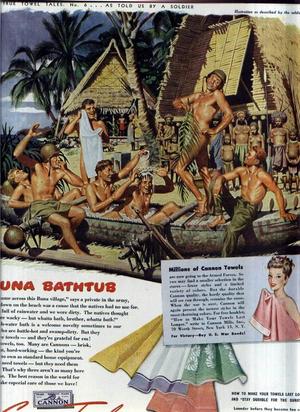
These are two rather odd print ads for towels from World War 2, and I've been trying to think through the purpose of the images. Of course, many ads from that era featured soldiers in one manner or another, and ads for towels such as these two would naturally feature a bathing scene like these. But in this day and age, the pictures strike me as being rather homoerotic. So what message is the artist trying to convey? Was he (or she) trying to titilliate the women back home while their boyfriends and husbands were off to war? That the troops were comfortable enough with their sexuality so that they could joke and frolick with each other while being nude? Or that the bond between fellow soldiers in a prolonged male environment (fighting in a war against other men) becomes stronger than normal, perhaps to the point of the men becoming gay?
One other thing to note in the above picture are the dark, silent natives in the background. They stand and stare at the white soldiers while the latter are oblivious to the spectacle they are creating.
From Boing Boing.

JTL - Enter the Dragon
As my regular readers know, I spent a year in Korea (2001-2). While living there, I was exposed to a lot of Korean pop music (K-Pop), which is the predominant style of music listened to there by the younger generation. While I didn't (and still don't) understand about 99.9% of the lyrics being sung, I do enjoy listening to the music for everything else (the melodies and harmonies, the passion in the singing, and so on).
In my year there, I bought about a dozen CDs from various artists. The below video is the title song from one of those albums. JTL is a trio of young men, the names of whom make up the band's name (as is popular to do among Korean bands in particular and east Asian bands in general). The song, "Enter the Dragon," of course is a tribute to Bruce Lee who makes a "sweaty" cameo in the video. ;) Run time: 4:31.
In my year there, I bought about a dozen CDs from various artists. The below video is the title song from one of those albums. JTL is a trio of young men, the names of whom make up the band's name (as is popular to do among Korean bands in particular and east Asian bands in general). The song, "Enter the Dragon," of course is a tribute to Bruce Lee who makes a "sweaty" cameo in the video. ;) Run time: 4:31.
May 13, 2006
Comet Schwassmann-Wachmann 3

One of the few problems of living in S'pore (at least from my perspective) is that you can rarely see the night sky. Living virtually on the equator (we're one degree north of), our skies are frequently overcast day and night, as it is right now. As a result, my trying to keep up with what's going on in astronomy is largely an internet affair.
Now, if you have the opportunity to look for Comet Schwassmann-Wachmann 3 in the northern sky, you should. This comet, which has actually broken up into about 60 fragments or so, is about to make its closest approach to Earth today (May 13). The comet is not going to be terribly bright (in part because it has broken up into numerous fragments instead of being a single, whole comet), about magnitude 4, and has just passed through the bottom part of the constellation Lyra (right past Messier 57, the Ring Nebula; see the picture below).
If you get the chance, check it out while you can.
Astronomy Picture of the Day's Caption for the above picture:
This false-color mosaic of crumbling comet Schwassmann-Wachmann 3 spans about 6 degrees (12 full moons) along the comet's orbit. Recorded on May 4-6 by an infrared camera on board the Spitzer Space Telescope, the picture captures about 45 of the 60 or more alphabetically cataloged large comet fragments. The brightest fragment at the upper right of the track is Fragment C. Bright Fragment B is below and left of center. Looking for clues to how the comet broke up, Spitzer's infrared view also captures the trail of dust left over as the comet deteriorated during previous passes. Emission from the dust particles warmed by sunlight appears to fill the space along the cometary orbit. The fragments are near their closest approach in the coming days, about 10 million kilometers away, and none pose any danger to our fair planet.

May 12, 2006
May 7, 2006
The Great Immigration Debate...
...of 1621. "And they lived happily ever after..." Yeah, right! Run time: 5:08.
May 6, 2006
Frogger
OK, this one is worth putting up too. Watch out for the car in the right-hand lane. Run time: 0:10.
Spock Casa
Another one of the Star Trek 2.0 animated commercials. This one is the long version (1:00), which I think is better than the short version. "Baby, no salsa on the leather! Keep it on the chips." :)
NeoConservative Manifesto
For "b." :) I'm sure your mom won't like this one either. ;) The video is very similar in theme to the "Unclassified" video below; I also like this guy's use of animation. Run time: 2:40.
"An Afternoon with the Hijjabed"
This is a short student film (8:29) from Multimedia University, near Kuala Lumpur, Malaysia. The video is a collection of interviews with five women, all of whom wear a tudung to one extent or another. Each of the women answer a series of questions (e.g., "What is aurat?" "Why do you wear the hijjab?" and so on) to the best of their abilities. The film is interesting in that it captures a cross-section of women who cover themselves for different reasons. You have the very traditional Zulaikha who wears both the tudung and niqab, Natasha, who wears a scarf that covers almost nothing for the least satisfactory reasons, and three others who all wear a traditional tudung although one, Wawa, a student, apparently would take hers off in public given the right circumstances (i.e., when she's with friends). Perhaps the line I liked the best is from the cigarette-smoking art director, Leyla, who said very directly, "I am a Muslim woman, and I'm not afraid to show it."
May 5, 2006
Unclassified
"What sort of community do you live in? Where would you place it on a democracy-despotism scale?" Run time: 8:26.
May 4, 2006
StarLords
Here is a set of two "movies" and three "trailers" that is both weird and LOL funny. (Unfortunately, they haven't put anything up at youtube.com just yet, otherwise I'd do my customary link.) However, if you have any interest in either the Star Wars or LOTR films, these are must-see. Essentially, they've taken snippets from all nine movies and have combined them in various ways. The three trailers are short and will give you a pretty good idea of how these guys think. (Trailer 1 , the "no" film, is particularly amusing.) The 45mb version of StarLords is a bit odd, being a straight edit film for the first half and a music video in the second half. They also use some odd choices for background music (Led Zeppelin in Trailer 3). Anyhoo... check it out.
"Paula, You're Fired!"
I'm not a terribly big fan of American Idol (although Milady is), but I did find this little snippet of information to be interesting:
More than half of adult voters for the Fox Broadcasting Company’s American Idol program value judge Simon Cowell’s opinion over that of the other judges in the 2006 season, according to a study released today by Pursuant, Inc. of Washington, D.C. The study found that 58 percent of voters respect Simon Cowell’s opinion the most. This is more than twice that of the 26 percent who value Randy Jackson’s opinion and nine times more than the 6 percent who value Paula Abdul’s. (Source)
This doesn't surprise me in the least. Cowell's comments, IMO, are spot on about 95% of the time. Jackson's comments can be decent, but he lapses all too often into "stroke the contestant's ego" mode (that and his frequent inanities like, "Yo, dog!" and "It's a hot one tonight!"). As for Abdul, she needs to be replaced immediately (actually, she should have been replaced after last year). It's amazing how often she's incoherent. She appears to listen to the music mostly on an emotional level, rarely listening to the music or the singer critically, and then gives little thought as to what she's actually going to say. To borrow Donald Trump's phrase, I'd say, "Paula, you're fired!"
One other comment I've told Milady in recent weeks is that if I were a music producer in, say, Nashville or Detroit, I'd be praying for Kelly Pickler and Paris Bennett to both lose (as they have). Those two in particular - along with Chris Daughtry - could have very successful careers, insha'allah. The remaining three finalists could also be successful, but I'd place my bets (if I were a betting man) over the long-term on Pickler, Bennett, and Daughtry because all three are very good in their niche (country, r&b, and rock) and all three of those niches are huge.
More than half of adult voters for the Fox Broadcasting Company’s American Idol program value judge Simon Cowell’s opinion over that of the other judges in the 2006 season, according to a study released today by Pursuant, Inc. of Washington, D.C. The study found that 58 percent of voters respect Simon Cowell’s opinion the most. This is more than twice that of the 26 percent who value Randy Jackson’s opinion and nine times more than the 6 percent who value Paula Abdul’s. (Source)
This doesn't surprise me in the least. Cowell's comments, IMO, are spot on about 95% of the time. Jackson's comments can be decent, but he lapses all too often into "stroke the contestant's ego" mode (that and his frequent inanities like, "Yo, dog!" and "It's a hot one tonight!"). As for Abdul, she needs to be replaced immediately (actually, she should have been replaced after last year). It's amazing how often she's incoherent. She appears to listen to the music mostly on an emotional level, rarely listening to the music or the singer critically, and then gives little thought as to what she's actually going to say. To borrow Donald Trump's phrase, I'd say, "Paula, you're fired!"
One other comment I've told Milady in recent weeks is that if I were a music producer in, say, Nashville or Detroit, I'd be praying for Kelly Pickler and Paris Bennett to both lose (as they have). Those two in particular - along with Chris Daughtry - could have very successful careers, insha'allah. The remaining three finalists could also be successful, but I'd place my bets (if I were a betting man) over the long-term on Pickler, Bennett, and Daughtry because all three are very good in their niche (country, r&b, and rock) and all three of those niches are huge.
May 3, 2006
A Matter of Perspective

This is Crater Galle. It's located on the eastern rim of the Argyre Planitia in the southern highlands of Mars, and is named after the German astronomer, Johann Gottfried Galle. The picture was taken by Mars Express, a satellite sent by the European Space Agency to photograph and perform a scientific survey on the red planet. This particular view of Galle looks northward. As you can see, Galle is a huge impact crater (although it's dwarfed by Argyre Planitia and Hellas Planitia, both of which are much, much larger). There's a long, curving mountain range in the middle, with a smaller crater to the northeast and a lone butte to the northwest.
Now, looking at this particular picture of Crater Galle, I'm reminded of how many non-Muslims look at Muslims and Islam. Just yesterday, there was a news account from CAIR-AZ where three Muslim women were verbally abused by an Islamophobic couple:
The three Muslim women say a white middle-aged couple approached them on April 29 at the Desert Ridge Marketplace in Scottsdale, Arizona, and asked whether they were Muslim. After learning that the women were in fact Muslims, the couple indicated they had seen "United 93" and then said: "Take off your f***ing burqas and get the f*** out of this country. We don't want you in this country. Go home." [Note: Two of the three women are American-born citizens.]
Unfortunately, as we know all too well, this type of abuse is commonplace in the U.S. and other countries. These non-Muslims don't know much (if anything) about Islam or how Muslims live their lives. Nor, I suspect, do most have any real desire to learn about Islam. And yet, as we Muslims know and tell the few who are willing to listen, the reality of Islam is very different from what most non-Muslims think. It's all a matter of perspective. Instead of looking at Islam askance, like the above view of Crater Galle, wouldn't it make more sense to look at Islam head on, as it really is? Then, insha'allah, people might realize the true beauty of Islam, just as looking at Crater Galle head on (below) gives a different, more pleasing picture.

May 1, 2006
Fridge Scare
A successful practical joke. (Kids, don't try this at home!) Run time: 1:03. Note: Some profanity.
April 29, 2006
What is Most Valuable?
This one came from my ustaz:
A Mufti sat next to a Reverend on a flight. The Reverend asked the Mufti, "What is your occupation?"
Mufti: "I'm into big business."
Reverend: "But what business exactly?"
Mufti: "I deal with God."
Reverend: "Ah, so you're a Muslim religious leader. I have one problem with you Muslims: you oppress your women."
Mufti: "How do we oppress women?"
Reverend: "You make your women cover up completely and you keep them in the homes."
Mufti: "Ah. I have a problem with you people: you oppress MONEY."
Reverend: "What? How can one oppress money?"
Mufti: "You keep your money hidden away, in wallets, banks and safes... You keep it covered up. Why don't you display it in public if it's a beautiful thing?"
Reverend: "It will get stolen, obviously."
Mufti: "You keep your money hidden because it is so valuable. We value the true worth of women far, far more. Therefore, these precious jewels are not on display to one and all. They are kept in honor and dignity."
A Mufti sat next to a Reverend on a flight. The Reverend asked the Mufti, "What is your occupation?"
Mufti: "I'm into big business."
Reverend: "But what business exactly?"
Mufti: "I deal with God."
Reverend: "Ah, so you're a Muslim religious leader. I have one problem with you Muslims: you oppress your women."
Mufti: "How do we oppress women?"
Reverend: "You make your women cover up completely and you keep them in the homes."
Mufti: "Ah. I have a problem with you people: you oppress MONEY."
Reverend: "What? How can one oppress money?"
Mufti: "You keep your money hidden away, in wallets, banks and safes... You keep it covered up. Why don't you display it in public if it's a beautiful thing?"
Reverend: "It will get stolen, obviously."
Mufti: "You keep your money hidden because it is so valuable. We value the true worth of women far, far more. Therefore, these precious jewels are not on display to one and all. They are kept in honor and dignity."
April 28, 2006
The Spirit of Truth
This has to be one of the most off-the-wall videos I've ever seen. The video was taken off of a Los Angeles' public access cable program (think "Wayne's World") back in May 1997. This particular version is highly edited, with a runtime of 2:34; there's also a longer version that's 8:11. Be warned! This guy is extremely profane (especially for a so-called Christian "preacher").
April 25, 2006
WWJD?
This video was made by Ava Lowrey, a fifteen-year-old girl from Alabama. I've looked at a few of her videos (she's done about 70 so far), and they're very well done. I think we'll be seeing a lot more of this young woman in the future.
For more videos, visit Peace Takes Courage.
Update: Not surprisingly, the wingnuts on the right are threatened by Ava's work, and have sent her the typical sexual taunts, accusations, and cowardly death threat that one would expect from wingnuts. For more information, see Animation Producer Gets Ugly Slurs
For more videos, visit Peace Takes Courage.
Update: Not surprisingly, the wingnuts on the right are threatened by Ava's work, and have sent her the typical sexual taunts, accusations, and cowardly death threat that one would expect from wingnuts. For more information, see Animation Producer Gets Ugly Slurs
April 21, 2006
April 20, 2006
Muslims Across the U.S.

This is an interesting map that I came across just a few minutes ago (the map is part of a Daily Kos diary, "So...where are all the Jews?". This map shows, on a county-by-county basis, where the American Muslim population is located as a percentage of the total resident population of the U.S. The data comes from the 2000 census. There are some fairly large populations of Muslims in places where I would expect (Michigan, Metro NY and DC), and a few where I wouldn't have expected (NW Ohio, NE Oregon (?), and two counties in New Mexico (??)). Also nice to see is that there is at least one county in every state that is shaded yellow (0.1 to 0.7% of the population), even in the upper mid-west and Alaska, where you wouldn't necessarily expect to find large numbers of Muslims. Of course, we have a long way to go before the map starts turning more yellow or, insha'allah, orange or brown.
For a listing of all the various maps for different religions practiced throughout the US, see here.
April 18, 2006
firaushah.com - the blog
 This post is to let my readers know that I'm going to semi-discontinue one of my other blogs, Dunner's Learn About Islam. All of those posts (and their respective comments) have been imported into my new blog, firaushah.com - the blog, which is associated with the new Islamic online store Milady and I have been creating, firaushah.com. That blog will continue with the DLAI tradition of answering questions about Islam and trying to correct the many misconceptions people have about Islam and Muslims; however, I will also use that blog to let my customers know about new products that firaushah.com will be selling. The purpose of firaushah.com is to beautify Muslims, both internally and externally, insha'allah, and I think these two sides coming together will both fulfill firaushah.com's mission and benefit you, my readers.
 In the meantime, I'm leaving DLAI up as it still gets a fair number of hits from people looking for information about Islam. However, firaushah.com - the blog will be getting all the new material, insha'allah. For those of you who have linked to DLAI (or would like to link to the new blog), the new URL is http://firaushah.com/blog/ .
April 17, 2006
Do It Vulcan Style, Baby!
I've started to come across ads and such for a new series on G4TV (a cable channel we don't have here in S'pore), called Star Trek 2.0. Apparently, the show will play re-runs of the original series. G4 has come out with three trailers for ST2.0, using stop-motion animation. While the trailers are a little strange, they're good enough for a laugh (e.g., Spock - with a black voice - calling Kirk a "white boy").
Star Trek Karaoke
Star Trek Coffee House
Star Trek Poolside
Star Trek Karaoke
Star Trek Coffee House
Star Trek Poolside
April 13, 2006
First Repercussion from Ports Fiasco?
[I originally posted this over at Daily Kos.]
While visiting one of my customers today, we fell into a discussion that touched on the recent ports management fiasco, where UAE-based Dubai Ports World had tried to purchase London-based Peninsular & Oriental, until the U.S. pulled a xenophobic histrionic fit.
The customer suggested that the ports fiasco had really opened the eyes of the Muslim world to Western attitudes toward Arabs and Muslims, and that a recent state visit to Singapore by Crown Prince Sultan of Saudi Arabia was a repercussion of that fiasco. He believes that the Middle East will look increasingly toward eastern Asia for trade, investment, and military cooperation and, indeed, all of these issues were discussed in the Sultan's state visit (which included trips to Japan and Pakistan).
Now state visits between national leaders are quite common, and the Singapore government (through MM Lee Kuan Yew) had made the initial visit. However, the fact that this was the first visit ever to Singapore by a Saudi official lends a little weight, I think, to my customer's argument. Even if this state visit was not motivated in any part by the ports fiasco, I do think that the relationship between the Middle East and east Asia will continue to grow stronger (to the detriment of the US and Europe) because of the anti-Muslim/Arab attitudes of Western nations.
While visiting one of my customers today, we fell into a discussion that touched on the recent ports management fiasco, where UAE-based Dubai Ports World had tried to purchase London-based Peninsular & Oriental, until the U.S. pulled a xenophobic histrionic fit.
The customer suggested that the ports fiasco had really opened the eyes of the Muslim world to Western attitudes toward Arabs and Muslims, and that a recent state visit to Singapore by Crown Prince Sultan of Saudi Arabia was a repercussion of that fiasco. He believes that the Middle East will look increasingly toward eastern Asia for trade, investment, and military cooperation and, indeed, all of these issues were discussed in the Sultan's state visit (which included trips to Japan and Pakistan).
Now state visits between national leaders are quite common, and the Singapore government (through MM Lee Kuan Yew) had made the initial visit. However, the fact that this was the first visit ever to Singapore by a Saudi official lends a little weight, I think, to my customer's argument. Even if this state visit was not motivated in any part by the ports fiasco, I do think that the relationship between the Middle East and east Asia will continue to grow stronger (to the detriment of the US and Europe) because of the anti-Muslim/Arab attitudes of Western nations.
Pregnant? Or Merely Fat and Stupid? You Decide.
 You have to wonder at the depths of deceit people will go to to get other people's money. Take the case of the Eversons of Grain Valley, Missouri:
The Eversons - Sarah, 45, and Kris, 33 - claimed to have given birth to four boys and two girls March 8. The babies were apparently in intensive care.
The tale exploded in the local spotlight Monday when The Examiner in Independence [Missouri] ran on its front page a photograph of the couple holding six one-piece baby outfits and announcing the births.
Those who heard the Eversons' sad story of tight finances set up a website to solicit contributions - including a new van, a washing machine and dryer, food, clothing, cash and gift certificates. A real estate agent was even working to find the family new housing.
Hours before admitting it was a scam, Sarah Everson showed an Associated Press reporter pictures of her in maternity clothes, her baring a huge pregnant-looking midsection, even sonogram images she claimed were of her infants. She showed off a tiny nursery, a closet full of baby clothes and the tiny diapers premature newborns must wear. She told of the surgeries two of the babies would undergo and detailed her discomfort during her pregnancy.
"I want to be with them all the time," she said, breaking into tears. "I don't like being away from them."
She said the entire story of her children's births was being kept secret by a court order enacted because a member of her husband's family was trying to kill the Eversons and their new sextuplets.
"I'm so afraid they're not going to make it," she sobbed. "Nobody understands how hard this is. I know that they're here. I know what I had to go through to get them here."
Of course, some people were skeptical...
“She’s been pregnant ten times since we’ve known her,” Helen Brown, the manager at a drive-in restaurant where Mrs Everson used to work, said.
...and the police naturally got involved:
Sarah Everson said a detective begin questioning her Tuesday evening; Bradley and Ambrose said the Eversons were interviewed at the police station for about an hour, during which they revealed the story was a scam. Officials have said that the Eversons expressed no remorse when they confessed to the hoax. They were released pending charges, and could face criminal charges for collecting cash and other gifts.
So why did they do it?
The couple [had] ...plenty of debts and had been sued for unpaid rent. “They said they needed the money to pay bills. It was definitely about money,” Aaron Ambrose, Grain Valley’s police chief, said.
The couple were married after meeting via a telephone chatline in March last year. It was the groom’s third marriage and the bride’s fourth. Mrs Everson soon began telling people that she was pregnant but spoke of her concern at the financial strain that six babies would impose on her and her husband.
In the meantime, editors at The Examiner, the newspaper that initially reported the story, are wiping major egg off their faces...
Examiner Editor Dale Brendel said he was considering a front-page column to readers addressing the issue. He said the incident would force a review of his reporters' verification practices.
"I think that we fell victim to the hoax. There were people out in the community who were doing fund-raisers already, and we feel bad for them and for us that we were the victims of that," Brendel said. "In retrospect, there were things we could have done better from a newspaper standpoint, in terms of our investigations and trying to flesh out some of the red flags there were about the story."
...and Sarah Everson is clamming up:
Reached by phone late Tuesday, Sarah Everson offered no explanation. "I'm not talking to anybody right now," she said, "because nobody gets it."
No, lady, you don't get it!
Sources:
Couple Conceive Sixfold Solution to a Bundle of Debts
Couple's Sextuplet Hoax Busted
Missouri Couple Admits Sextuplets Story Was a Hoax
April 11, 2006
But You Already Knew That

There's an interesting article over at firedoglake by Matt O., called "What Lies Beneath." The article goes into detail about the highly racist comments that LGF readers make over at that website. Two excerpts from the article:
Frequently readers post comments with racial slurs such as “raghead” and “mooselimbs,” racist anecdotes, castration, charges of a low intellect, wiping their rear with the Koran, calls for a new crusade, violence towards and mass murder of all Muslims, the destruction of Islam and white supremacist-esque language like “It’s time we asserted our culture” and “moral and cultural superiority.” It seems that liberals are now by definition terrorists and labeled as such. They speak of Arabs and Muslims in much the same ways that a racist southerner would speak of blacks in the 1950s.
...
If Charles [Johnson, Executive Editor of LGF] himself is not racist as he claims, though I emphatically disagree, LGF certainly is a “safe haven” for racists. It is a website that “harbors” racists. Readers that claim a moral, religious, racial and cultural superiority are consumed with an unfathomable hatred for Muslims and Arabs. They are provided with a forum where there are no consequences for their words. Instead, such responses are encouraged and thinly covered-up. Racism is what lies beneath.
But you already knew that.
April 8, 2006
Jesus (pbuh) Walked On...Ice?
Stories about the Gospel of Judas have been the rage the past few days, but I find this story even more interesting. (And the Christians are sending one hate e-mail every three minutes or so, according to the professor.)
Jesus walked on water, according to the Bible, but a professor says he may have actually walked on a hard-to-see patch of ice.
Doron Nof, a Florida State University professor of oceanography, said a rare combination of water and atmospheric conditions in the Sea of Galilee about 2,000 years ago may offer a scientific explanation for one of the miracles recounted in the Bible.
Nof, a native of Israel, said a patch of ice floating in the Sea of Galilee, which is actually a freshwater lake, would have been difficult to distinguish from unfrozen water surrounding it.
"I'm not trying to provide any information that has to do with theology here," Nof said in an interview Wednesday. "All we've thought is about the natural process. What theologians or anybody else does with that, it's their business, so to speak."
According to the New Testament books of Matthew, Mark and John, Jesus' disciples were out on the Galilee at night when a storm came up. Jesus walked to the terrified men, who thought he was a ghost, according to the accounts.
...
Nof's research appears in the April issue of the Journal of Paleolimnology, a publication on the reconstruction of lake histories. Nof's co-authors are biostatistics professor Ian McKeague of Columbia University and atmospheric science professor Nathan Paldor of Hebrew University of Jerusalem.
They came up with the theory after studying records of long-ago water temperatures in the Mediterranean Sea, based on core samples of shells and other animal remains taken from the bottom.
The records indicated that two lengthy periods 2,500 to 1,500 years ago were chilly enough for ice patches to form during cold spells on the Sea of Galilee, said Nof.
The unfrozen water surrounding the ice would have come from salty springs along the lake's western shore, he said. Salty water freezes at lower temperatures than fresh water.
Jesus walked on water, according to the Bible, but a professor says he may have actually walked on a hard-to-see patch of ice.
Doron Nof, a Florida State University professor of oceanography, said a rare combination of water and atmospheric conditions in the Sea of Galilee about 2,000 years ago may offer a scientific explanation for one of the miracles recounted in the Bible.
Nof, a native of Israel, said a patch of ice floating in the Sea of Galilee, which is actually a freshwater lake, would have been difficult to distinguish from unfrozen water surrounding it.
"I'm not trying to provide any information that has to do with theology here," Nof said in an interview Wednesday. "All we've thought is about the natural process. What theologians or anybody else does with that, it's their business, so to speak."
According to the New Testament books of Matthew, Mark and John, Jesus' disciples were out on the Galilee at night when a storm came up. Jesus walked to the terrified men, who thought he was a ghost, according to the accounts.
...
Nof's research appears in the April issue of the Journal of Paleolimnology, a publication on the reconstruction of lake histories. Nof's co-authors are biostatistics professor Ian McKeague of Columbia University and atmospheric science professor Nathan Paldor of Hebrew University of Jerusalem.
They came up with the theory after studying records of long-ago water temperatures in the Mediterranean Sea, based on core samples of shells and other animal remains taken from the bottom.
The records indicated that two lengthy periods 2,500 to 1,500 years ago were chilly enough for ice patches to form during cold spells on the Sea of Galilee, said Nof.
The unfrozen water surrounding the ice would have come from salty springs along the lake's western shore, he said. Salty water freezes at lower temperatures than fresh water.
April 6, 2006
Peace and Love in the Qur'an
Dr. Juan Cole, over at Informed Comment, normally blogs about modern Middle Eastern politics and current events. However, he's recently written up some very good explanations (tafsir) regarding five (so far) Qur'anic ayat, under the general heading, Peace and Love in the Qur'an. The five ayat are:
4:90
4:94
5:82
25:63
28:55
Check it out.
4:90
4:94
5:82
25:63
28:55
Check it out.
April 5, 2006
Sir Charles

Charles Barkley, one of my favorite NBA players, has been elected to the Naismith Memorial Basketball Hall of Fame in his first year of consideration.
Barkley, of course, played for the Phoenix Suns from '92 through '96, and immediately led the Suns into the NBA Finals, where they lost to the Chicago Bulls. Those were very good years for Suns basketball, and it was a pleasure to watch Barkley play those four years. (In fact, I liked Barkley's signature move, where he backed in toward the basket, so much that I now hate the "Barkley Rule" (where the player has a 5-second time limit before he has to make an offensive move).) And then there were the numerous ... heck, daily ... stories and quotations to look forward to (if you didn't live within viewing distance of Philly, Phoenix or Houston TV stations, you don't know what you missed).
While Barkley could have handled his departure from the Suns better, I'm glad that he and Jerry Colangelo have "kissed and made up." Barkley is now only the third member of the Suns organization to have been elected to the Basketball Hall of Fame (along with Colangelo and Cornelius L. "Connie" Hawkins), and is one of 11 men in the Suns' Ring of Honor. The following is a brief biography for Sir Charles:
CHARLES BARKLEY, a native of Leeds, Alabama and attended Auburn University in Alabama, Barkley averaged 14.1 points per game and 9.6 rebounds per game in his career at Auburn. During his career with the Philadelphia 76ers (1984-1992), the Phoenix Suns (1992-1996) and the Houston Rockets (1996-2000), Barkley was selected to 11 NBA All-Star games as well as the All-NBA First Team five times and the All-NBA Second Team five times. He won an Olympic gold medal with the 1992 United States Olympic Dream Team and was the NBA’s Most Valuable Player in the 1993 season. A member of the NBA’s 50th Anniversary team, Barkley averaged 22.1 points per game and almost 12 rebounds per game in his 16-year NBA career. He shares the single game record for most offensive rebounds in one quarter (11 in 1987).
April 3, 2006
A bear, a lion, and a chicken...
 A cute joke, from MENJ:
A bear, a lion and a chicken meet.
The bear says: "If I roar in the forests of North America, the entire forest is shivering with fear."
The lion says: "And if I roar on the great plains of Africa, the entire savannah is afraid of me."
Says the chicken: "Big deal. I only have to cough and the entire planet $#|+$ itself."
March 30, 2006
I Can't Dance
More videos to share, this one being the first of five. As Milady has learned all too well, my taste in videos frequently runs toward the absurd. One of my guilty pleasures is watching programs like MaxEx, where the global village idiots (mostly white Americans) do very stupid things on video and get their comeuppance (like in the second picture on my "American Chopper?" post. This video and the next two are variations on that theme, although the pain these people undergo isn't as intense as in some other videos I could show you. Anyhoo... what makes this particular video fun for me is that it's mostly about people trying to dance who can't. (I frequently "dance" for Milady and, while I've never gotten hurt from doing so, I generally elicit howls of laughter for my efforts. ;) ) Run time: 1:23.
Watersports
I'm not sure if this is an AFV compilation, although it has the look and feel of one. Regardless, I play this one fairly often on the home PC. Run time: 1:34.
March 28, 2006
What will they call Glacier National Park...
...when there are no glaciers left?
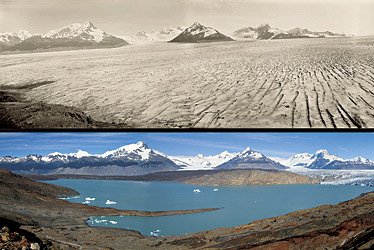
This is an interesting set of photos from Time Magazine's article on global warming. As you can see, the Upsala Glacier, located in Argentina, has retreated dramatically over the decades. The top photo was taken in 1928, the bottom photo in 2004. All that is left now are a few stubs of glaciers off in the distance and a lake.
One of my sisters (who is intelligent enough to know better) is in complete denial over global warming. She, the red state conservative, blithely dismisses global warming as "a liberal conspiracy." One wonders what would convince her? When the Maldives disappear beneath the waves? Tuvalu? Kiribati? Tokelau? The Marshall Islands? Bangladesh? (One suspects Washington D.C.)
In the late '70s, the National Park Service had a series of t-shirts available that started with the word "Go." "Go hike the canyon" was the t-shirt I owned, after visiting the Grand Canyon. A colleague, who had visited Glacier National Park, would wear a t-shirt that read, "Go climb a glacier." If you have any desire to climb (or even see) a glacier, now would be the time. Or, to modify a New York Times headline slightly, "Race to Alaska Before It Melts."
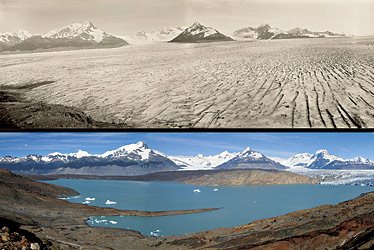
This is an interesting set of photos from Time Magazine's article on global warming. As you can see, the Upsala Glacier, located in Argentina, has retreated dramatically over the decades. The top photo was taken in 1928, the bottom photo in 2004. All that is left now are a few stubs of glaciers off in the distance and a lake.
One of my sisters (who is intelligent enough to know better) is in complete denial over global warming. She, the red state conservative, blithely dismisses global warming as "a liberal conspiracy." One wonders what would convince her? When the Maldives disappear beneath the waves? Tuvalu? Kiribati? Tokelau? The Marshall Islands? Bangladesh? (One suspects Washington D.C.)
In the late '70s, the National Park Service had a series of t-shirts available that started with the word "Go." "Go hike the canyon" was the t-shirt I owned, after visiting the Grand Canyon. A colleague, who had visited Glacier National Park, would wear a t-shirt that read, "Go climb a glacier." If you have any desire to climb (or even see) a glacier, now would be the time. Or, to modify a New York Times headline slightly, "Race to Alaska Before It Melts."
Subscribe to:
Posts (Atom)